
Why Multi-State Income Creates Tax Complexity
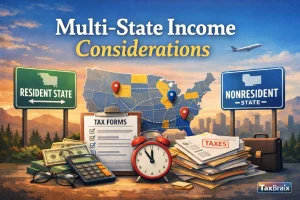
Multi-state income issues arise when income is connected to more than one state during the same tax year. This can happen even when income feels simple, consistent, or tied to a single job. Once more than one state has a legitimate claim to tax the same income, filing and reporting obligations become more complex.
At a basic level, states tax income based on two ideas:
- Where you live
- Where income is earned
When those two do not align, multi-state considerations come into play.
This situation is far more common than many taxpayers expect. It affects:
- Employees who live in one state and work in another
- Remote workers whose employer is located in a different state
- Individuals who move during the year
- Self-employed individuals who perform services across state lines
- Small business owners with customers, projects, or operations in multiple states
In these cases, filing obligations often extend beyond a single state, even when federal filing remains unchanged.
Multi-state income issues are frequently overlooked because state tax compliance feels secondary to federal tax filing. Many taxpayers assume that filing one federal return and one state return is sufficient. In reality, state tax rules operate independently, and income that crosses state boundaries can create multiple filing requirements.
Another reason multi-state issues cause confusion is that withholding does not determine tax liability. Employers may withhold tax for only one state, or may withhold incorrectly when work locations change. This can create a false sense of compliance that only becomes apparent after notices are issued or refunds are delayed.
The complexity is not limited to higher-income taxpayers or large businesses. Small amounts of income earned in another state can still:
- Trigger a nonresident filing requirement
- Require allocation of income between states
- Affect credits for taxes paid to another state
Because each state sets its own rules, there is no single standard approach that applies everywhere. The Internal Revenue Service plays a limited role here, primarily through federal income reporting that states use as a starting point. The actual tax obligations are determined at the state level.
This page focuses on how and why multi-state income creates tax obligations, not on filing mechanics or form instructions. It explains the principles states use to tax income, the situations that commonly trigger multi-state filings, and the mistakes that lead to double taxation or missed returns.
It is designed to work alongside State Income Tax Basics and Federal Income Tax Basics. Those pages explain how each system works on its own. This page explains what happens when income crosses state lines and those systems overlap.
Understanding multi-state income considerations early helps taxpayers:
- Identify required state returns
- Avoid double taxation
- Correct withholding issues sooner
- Reduce the risk of state audits or notices
The sections that follow break down these concepts step by step, starting with how states determine who they can tax and why residency and income source matter so much in multi-state situations.
Table of Contents
How States Tax Income: Core Principles
Before looking at specific multi-state scenarios, it helps to understand the basic principles states use to decide when they can tax income. While details vary by state, the underlying framework is largely consistent across jurisdictions.
At the most fundamental level, states tax income based on residency and income source. Multi-state issues arise when one or both of these connect a taxpayer to more than one state in the same year.
Residency vs Source-Based Taxation
States generally assert taxing authority in two ways:
Residency-based taxation
If you are considered a resident of a state, that state typically claims the right to tax:
- All income, regardless of where it was earned
- Income from wages, self-employment, investments, and other sources
This is why resident returns often include income earned outside the state, even when another state also taxes that income.
Source-based taxation
If you earn income that is sourced to a state where you are not a resident, that state may still tax:
- Wages for work performed in the state
- Income from services performed in the state
- Business or rental income connected to the state
This is the basis for nonresident tax returns.
Multi-state complexity exists because both principles can apply to the same income at the same time. One state taxes the income because you live there. Another taxes it because the income was earned there.
Resident, Nonresident, and Part-Year Resident Status
To apply these principles, states classify taxpayers into one of three broad categories:
Resident
A resident is generally someone who:
- Lives in the state permanently, or
- Is domiciled in the state
Residents are usually taxed on all income from all sources, subject to credits for taxes paid to other states.
Nonresident
A nonresident is someone who:
- Does not live in the state, but
- Earns income sourced to the state
Nonresidents are taxed only on income connected to that state, not on worldwide income.
Part-year resident
A part-year resident:
- Lived in the state for part of the year
- Lived elsewhere for the remainder
Part-year residency often results in:
- Income being split between states
- More than one state return for the year
This classification is especially common when someone moves mid-year or changes work locations.
Why Classification Matters More Than Income Amount
Many taxpayers assume that small amounts of out-of-state income do not matter. In reality, classification often matters more than dollar amount.
Even modest income can:
- Trigger a nonresident filing requirement
- Require income allocation between states
- Affect credits for taxes paid to other states
States generally focus first on whether they have the right to tax, not how much tax is ultimately due. Filing thresholds and exemptions vary widely, and some states require filing simply to reconcile withholding.
Federal Income as the Common Starting Point
Although states set their own tax rules, most rely on federal income figures as a starting point. Federal adjusted gross income is often used to:
- Establish baseline income
- Match income reported to states
- Identify taxpayers with potential filing obligations
The Internal Revenue Service plays an indirect role by providing the federal reporting framework that states build on. However, federal compliance does not determine state compliance.
A taxpayer can be fully compliant federally and still have unresolved state filing obligations.
Why These Principles Create Overlap
Multi-state tax issues arise because:
- Residency-based taxation looks at where you live
- Source-based taxation looks at where income is earned
- States apply these rules independently
This overlap is intentional, not accidental. States rely on credits and allocation rules to reduce double taxation, but those mechanisms only work when returns are filed correctly in all applicable states.
Understanding these core principles makes it easier to recognize when multi-state income issues exist and why they cannot be resolved by filing a single state return.
The next section builds on this foundation by explaining how states determine residency, including the factors that matter most when more than one state claims you as a resident.
Determining State Residency
State residency is one of the most important factors in multi-state income taxation. It determines which state can tax all of your income, not just income earned within its borders. When residency is unclear or disputed, multi-state tax problems often follow.
Understanding how states define and evaluate residency helps explain why some taxpayers are required to file in more than one state, even when they believe they “only live in one place.”
Domicile vs Physical Presence
Most states distinguish between domicile and physical presence. These concepts are related, but not the same.
Domicile
Your domicile is generally considered your permanent home. It is the place you intend to return to whenever you are away. You typically have only one domicile at a time.
Domicile is based on intent, not just location. It does not change automatically when you:
- Take a temporary job elsewhere
- Rent an apartment in another state
- Travel frequently for work
Physical presence
Physical presence refers to where you are actually located during the year. Some states use presence tests, such as the number of days spent in the state, to determine whether you are treated as a resident for tax purposes.
In many cases:
- You can be domiciled in one state
- Physically present in another for extended periods
This is where residency disputes often begin.
Common Residency Factors States Consider
Because intent is difficult to measure directly, states look at objective indicators to determine residency. No single factor is usually decisive. Instead, states evaluate the overall picture.
Common factors include:
- Where you maintain a permanent home
- Where your spouse and dependents live
- Where you spend the majority of your time
- Driver’s license and vehicle registration
- Voter registration
- Address used for financial accounts and tax filings
- Location of personal property
States may weigh these factors differently, but inconsistencies across them often trigger questions or audits.
Day Count Rules and Presence Tests
Some states apply statutory day count rules, which can treat you as a resident if you spend more than a certain number of days in the state during the year.
These rules often:
- Apply even if you are domiciled elsewhere
- Operate independently of income level
- Catch remote workers and frequent travelers by surprise
Keeping accurate records of time spent in different states is especially important when:
- Working remotely
- Traveling frequently for business
- Maintaining homes in more than one state
Why You Are Usually a Resident of Only One State
In most situations, you are considered a resident of only one state at a time for income tax purposes. That state claims the right to tax your worldwide income.
However, problems arise when:
- Two states believe you meet their residency criteria
- Domicile is unclear or poorly documented
- Physical presence thresholds are exceeded unintentionally
When two states both treat you as a resident, double taxation becomes a real risk, and credits alone may not fully resolve the issue.
Residency Changes and Intent to Move
Residency can change, but it usually requires more than simply leaving a state or arriving in another.
States look for:
- Clear intent to abandon the old domicile
- Clear intent to establish a new one
This often involves:
- Moving personal belongings
- Changing licenses and registrations
- Establishing new community and financial ties
Failing to complete these steps consistently can result in a taxpayer being treated as a resident by the old state longer than expected.
Why Residency Determination Is a Common Audit Trigger
Residency affects how much income a state can tax, which makes it a frequent focus of enforcement. States are especially attentive when:
- High income is involved
- A taxpayer claims nonresidency after living in the state for years
- Work patterns or remote arrangements change
The Internal Revenue Service does not determine state residency, but federal income reporting often provides the data states use to identify potential residency issues.
Understanding how residency is determined helps taxpayers recognize when multi-state filing obligations exist and why careful documentation matters. The next section explains what happens when residency changes during the year and how part-year residency affects state tax filing.
Part-Year Residency and Moving Between States
Moving from one state to another during the year creates part-year residency, one of the most common and misunderstood multi-state tax situations. Even when a move feels straightforward, state tax obligations rarely divide as cleanly as a calendar date.
This section explains what part-year residency means, how income is allocated, and where mistakes often occur.
What Creates Part-Year Resident Status
You are generally considered a part-year resident when you:
- Are a resident of one state for part of the year, and
- Establish residency in another state during the same year
This typically happens when you:
- Move permanently to another state
- Change domicile during the year
- Relocate for work, family, or long-term personal reasons
Temporary travel or short-term work assignments usually do not create part-year residency on their own. The key factor is a change in residency, not just location.
How Income Is Split Between States
Part-year residency usually requires allocating income between states based on when and where it was earned.
In general:
- Income earned while you were a resident of State A is taxable by State A
- Income earned after becoming a resident of State B is taxable by State B
However, income does not always follow pay dates neatly. Allocation depends on:
- When the income was earned, not when it was paid
- Where services were performed
- The nature of the income
For example:
- Wages are often allocated based on work dates
- Self-employment income may require allocation based on activity
- Bonuses and deferred compensation may follow special sourcing rules
This is where part-year filings become more complex than full-year resident or nonresident returns.
Filing Requirements When You Move
Most part-year moves result in two state tax returns:
- A part-year resident return for the old state
- A part-year resident return for the new state
Each return reports:
- Worldwide income for the period of residency
- Only state-sourced income outside that period
Some taxpayers incorrectly file one full-year resident return and one nonresident return. This approach often leads to:
- Overreporting income
- Incorrect credits
- State notices or adjustments
Using the correct part-year status is essential for accurate reporting.
Common Timing Issues Around Moves
Timing plays a major role in part-year residency, and small details can have outsized effects.
Common problem areas include:
- Moves late in the year
- Income earned near the move date
- Bonuses paid after a move but earned before it
- Stock compensation or commissions tied to prior work
Without careful attention, income can be taxed by the wrong state or by both states incorrectly.
Withholding Errors During a Move
Employer withholding often does not adjust automatically when a move occurs. This can result in:
- Withholding continuing for the old state after the move
- No withholding for the new state
- Withholding split incorrectly between states
Incorrect withholding does not change tax liability. It only affects how much has been prepaid. Filing the correct part-year returns is still required to reconcile the actual tax owed.
Credits and Double Taxation Concerns
During a move, it is possible for both states to tax the same income if:
- Residency dates are unclear
- Income is misallocated
- Returns are filed incorrectly
Credits for taxes paid to another state may help, but they:
- Are not automatic
- Must be claimed correctly
- Often apply only to resident returns
Relying on credits to fix allocation errors often leads to avoidable complications.
Why Moves Trigger State Scrutiny
State tax authorities often pay close attention to years in which a taxpayer moves. These years commonly involve:
- Changes in residency
- Inconsistent address information
- Shifts in withholding
- Large income amounts near move dates
States use federal income data as a reference point, and information reported to the Internal Revenue Service is frequently shared with states for matching and enforcement.
Why Careful Documentation Matters
Clear documentation helps support part-year residency positions. This includes:
- Move dates
- Lease or home purchase records
- Employment changes
- Updated licenses and registrations
When documentation is incomplete, states may default to assumptions that increase tax exposure.
Understanding part-year residency helps ensure that income is taxed by the right state, at the right time. The next section explains how states tax income earned by nonresidents, even when residency never changes.
Nonresident Income: When States Can Tax You
You do not need to live in a state for that state to tax your income. Nonresident taxation allows states to tax income that is connected to activity within their borders, even when the taxpayer lives elsewhere.
This is one of the most common sources of unexpected state filing obligations.
Income Earned Physically in Another State
States generally have the right to tax income earned for work performed within the state, regardless of where you live.
This commonly applies to:
- Employees who travel to another state for work
- Temporary or short-term job assignments
- Project-based work performed on-site in another state
In these cases, wages are typically sourced to the state where the work is physically performed, not where the employer is located and not where the paycheck is issued.
Even a relatively short period of work in another state can create:
- A nonresident filing requirement
- Tax liability to that state
- The need to allocate wages by work location
Source Rules for Nonresident Income
Each state defines how income is “sourced,” but most follow similar principles.
Common sourcing rules include:
- Wages: based on where services are performed
- Self-employment income: based on where the work is performed
- Rental income: based on where the property is located
- Business income: based on where business activity occurs
A frequent misconception is that income is sourced to the employer’s location or the taxpayer’s residence. In reality, physical activity often controls, especially for wages and services.
Filing Requirements for Nonresidents
When income is sourced to a state, that state may require a nonresident tax return, even if:
- Income earned in the state was relatively small
- No tax was ultimately owed after credits
- Tax was already withheld
Some states have de minimis thresholds, but others require filing simply to reconcile withholding or confirm tax treatment.
Nonresident returns typically report:
- Only income sourced to that state
- Allocated wages or business income
- Credits or exemptions allowed under state law
Withholding Does Not Eliminate Filing Obligations
Employers often withhold state tax for nonresident income, but withholding alone does not satisfy filing requirements.
A return is still needed to:
- Confirm the correct amount of tax
- Claim a refund if too much was withheld
- Apply credits correctly
Relying on withholding without filing is a common reason nonresident taxpayers receive state notices years later.
Nonresident Income and Multiple States
It is possible to be a nonresident in more than one state in the same year. This can happen when:
- You work on projects in multiple states
- You travel frequently for work
- You perform services across state lines
In these cases, multiple nonresident returns may be required, each reporting income sourced to that state.
Credits and the Resident State Return
When a nonresident state taxes your income, your resident state may also tax that same income because residents are typically taxed on all income from all sources.
This overlap is usually addressed through:
- Credits for taxes paid to another state
- Allocation rules on the resident return
However, these credits:
- Are not automatic
- Must be claimed properly
- Often depend on filing correct nonresident returns first
Errors at the nonresident level often carry through to the resident return.
Why Nonresident Filing Is Commonly Missed
Nonresident filing obligations are often overlooked because:
- Income feels temporary or incidental
- Withholding creates a sense of completion
- The taxpayer never “lived” in the state
- The income amount seems too small to matter
States routinely identify unfiled nonresident returns by matching income data reported through the Internal Revenue Service with state filings.
Understanding when states can tax nonresident income helps taxpayers identify filing obligations early and avoid surprise notices, penalties, or lost refunds. The next section explains how these rules apply in multi-state employment and remote work situations, where income location is even less intuitive.
Multi-State Employment and Remote Work
Multi-state employment has become one of the most common sources of state tax confusion, especially as remote and hybrid work arrangements have expanded. When work location, employer location, and residence do not align, state tax obligations often extend beyond what taxpayers expect.
This section explains how states typically tax employment income when work crosses state lines and why withholding is frequently incorrect in these situations.
Working in One State While Living in Another
Traditional multi-state employment often involves living in one state and commuting to another. In these cases, the general framework looks like this:
- The work state taxes wages earned for work performed there
- The resident state taxes all income but typically allows a credit for taxes paid to the work state
This usually results in:
- A nonresident return filed in the work state
- A resident return filed in the home state
Even when this pattern is consistent year after year, filing in both states is often required.
Some neighboring states have reciprocal agreements that modify this arrangement. These agreements may:
- Allow wages to be taxed only by the state of residence
- Eliminate the need for a nonresident return in the work state
However, reciprocity is limited and highly specific. Assuming an agreement exists without confirming it is a common mistake.
Remote Work and Where Income Is Earned
Remote work has complicated state tax rules because physical presence no longer matches employer location.
In most cases:
- Wages are sourced to the state where the work is physically performed
- Employer location alone does not control taxation
- Living and working remotely from a different state can create new tax obligations
For example, working remotely from State A for an employer located in State B may result in:
- State A treating the income as earned locally
- State B withholding tax incorrectly based on employer location
This disconnect often leads to under-withholding in one state and over-withholding in another. Read more at Remote Work Tax Obligations page.
Temporary Remote Work vs Long-Term Arrangements
Not all remote work is treated the same. States may distinguish between:
- Short-term or incidental remote work
- Long-term or permanent remote arrangements
Factors that can matter include:
- Length of time working remotely from a state
- Regularity of work performed there
- Whether remote work is optional or required
While some states may overlook brief or incidental remote work, longer-term arrangements are far more likely to create filing obligations.
Employer Withholding Errors in Multi-State Work
Employer withholding is often incorrect in multi-state and remote work situations because:
- Employers may withhold based on office location rather than work location
- Payroll systems may not update when work locations change
- Remote work may not be reported clearly to payroll departments
Incorrect withholding:
- Does not determine which state can tax the income
- Does not eliminate filing requirements
- Does not fix sourcing errors
Filing the correct state returns is still required to reconcile actual tax liability, even when withholding was wrong.
Convenience Rules and Employer-Based Sourcing
Some states apply special sourcing rules that tax wages based on employer location rather than work location in certain situations. These rules often apply when:
- Work is performed remotely for the employee’s convenience
- The employer’s office is located in the taxing state
These rules are controversial and vary significantly by state. They are a frequent source of double taxation and disputes.
Understanding whether such a rule applies requires careful analysis of:
- Employer policies
- Work necessity
- State-specific definitions
Filing Obligations in Remote and Hybrid Scenarios
Remote and hybrid work arrangements often result in:
- Multiple state filing requirements
- A mix of resident, nonresident, and part-year returns
- Credits for taxes paid to other states
Filing obligations exist even when:
- Income is earned entirely from home
- No state tax was withheld
- The employer is unaware of the issue
States often identify remote work issues by matching federal income data reported through the Internal Revenue Service with employer withholding records.
Why Multi-State Employment Issues Are Often Missed
These issues are commonly overlooked because:
- Work feels centralized even when it is not
- Payroll withholding appears to “handle” taxes
- Remote work arrangements evolve informally
Unfortunately, state tax rules are less flexible than work arrangements. When income crosses state lines, filing obligations follow, whether they are obvious or not.
The next section explains how these challenges expand further when income comes from self-employment and independent business activity, where no employer is involved at all.
Self-Employment and Multi-State Income
Multi-state income issues are often more complex for self-employed individuals than for employees. Without an employer to manage withholding or track work locations, self-employed taxpayers must determine for themselves where income is sourced and which states can tax it.
This section explains how self-employment changes state tax exposure and why multi-state filing is common even for small or part-time businesses.
How Self-Employment Changes State Tax Exposure
Self-employed individuals are not tied to a single workplace or payroll system. Income is earned through activities performed by the taxpayer, which makes location of activity the key factor in state taxation.
Unlike employees:
- There is no automatic state withholding
- Income is not reported by an employer by state
- Work may be performed in multiple locations without clear boundaries
Because of this, self-employed taxpayers often create state tax obligations without realizing it.
Common examples include:
- Traveling to another state to perform services
- Working on-site for clients in different states
- Temporarily relocating while continuing to work
- Performing services remotely while physically present in another state
In each case, where the work is performed matters, regardless of where clients are located or payments are received.
Where Self-Employment Income Is Taxed
Most states tax self-employment income based on where services are performed, not where:
- The client is located
- The business is registered
- Payments are deposited
For example:
- Consulting services are typically sourced to the state where the consulting work is performed
- Creative or technical services follow the location of the individual performing the work
- Professional services are often sourced to the location of the service activity
This means a self-employed individual can create filing obligations simply by performing services while physically present in another state, even for a short period.
Location of Customers vs Location of Work
A common misconception is that income is taxed where customers are located. For many self-employed activities, this is not the controlling factor.
In most service-based businesses:
- Customer location is irrelevant
- Work location controls income sourcing
However, for businesses involving:
- Tangible goods
- Rentals or property
- Certain digital or platform-based activities
States may apply different sourcing rules. This variability is a major reason self-employed taxpayers face uncertainty in multi-state situations.
Filing in Multiple States as a Sole Proprietor
Self-employed individuals often need to file multiple state returns when income is earned across state lines.
This commonly involves:
- A resident return in the home state
- One or more nonresident returns in states where services were performed
Each nonresident return typically reports:
- Only income sourced to that state
- Allocated business income based on activity
Filing requirements can apply even when:
- Income earned in the other state was relatively small
- Work was performed only briefly
- No state tax was withheld
Estimated State Tax Payments for Multi-State Self-Employment
Because there is no withholding, self-employed individuals may be required to make estimated tax payments to multiple states.
This can occur when:
- Income is earned consistently in more than one state
- Nonresident states require payment during the year
- Resident states tax worldwide income without sufficient credits
Failing to make required estimated payments can result in penalties, even if returns are filed correctly.
Recordkeeping Challenges in Multi-State Self-Employment
Accurate recordkeeping is especially important for self-employed taxpayers with multi-state income. Useful records include:
- Dates and locations of work performed
- Travel records
- Client agreements and project details
- Income by project or location
Without this information, income allocation becomes guesswork, which increases the risk of errors and disputes.
Why Self-Employed Multi-State Issues Are Often Discovered Late
Multi-state issues for self-employed individuals are often identified:
- After several years of unfiled nonresident returns
- When a state issues a notice based on income data
- During an audit or review
States commonly use federal income information reported through the Internal Revenue Service as a starting point, then look for state filings that match that activity.
Why This Matters for Small and Growing Businesses
For many self-employed individuals, multi-state income begins informally and grows over time. What starts as an occasional out-of-state project can quietly become a pattern that requires regular multi-state filing.
Understanding these rules early helps prevent:
- Missed nonresident returns
- Accumulated penalties and interest
- Difficulty allocating income retroactively
The next section expands this discussion to small businesses operating across state lines, where income flows to owners but state exposure can increase rapidly as activity expands.
Small Businesses Operating Across State Lines
When a small business operates across state lines, state tax obligations often expand faster than expected. Unlike large corporations with dedicated compliance teams, small business owners frequently create multi-state exposure without realizing it, simply by growing, traveling, or serving out-of-state clients.
This section focuses on how multi-state activity affects owners of small, pass-through businesses, not corporations.
What Creates a State Filing Obligation for a Small Business Owner
For state income tax purposes, filing obligations are usually triggered by business activity, not by business registration alone.
Common activities that can create state tax exposure include:
- Performing services physically in another state
- Having employees or contractors work in another state
- Operating from temporary or rotating locations
- Owning or leasing property in another state
- Regularly conducting in-person business activities
For many small businesses, these activities occur gradually and informally. A single project, short-term engagement, or temporary presence can still be enough to create a filing obligation.
Physical Presence vs Economic Presence (High-Level)
Traditionally, states focused on physical presence, such as:
- Offices
- Employees
- On-site work
More recently, some states have expanded their rules to include economic presence, which looks at:
- Amount of income earned in the state
- Volume of transactions
- Ongoing business activity
For small businesses, this means that crossing state lines physically is no longer the only risk. Even businesses that operate primarily online or remotely may create state tax obligations depending on how and where income is earned.
Pass-Through Businesses and Owner-Level Taxation
Most small businesses are pass-through entities, meaning:
- The business itself does not pay state income tax
- Income flows through to the owner’s personal return
- Owners file state returns based on where income is sourced
This structure creates a common surprise: business activity in another state can require the owner to file there personally, even if the owner does not live in that state.
For example:
- A sole proprietor performing services in another state may need to file a nonresident return there
- A single-member LLC earning income across state lines may require filings in multiple states at the owner level
Business Income Allocation Across States
When a small business operates in more than one state, income must often be allocated or apportioned between states.
Allocation methods vary, but often consider:
- Where services are performed
- Where business activities take place
- Time spent or revenue generated in each state
For service-based businesses, allocation frequently depends on where the work is actually performed, not where clients are located or payments are received.
Incorrect allocation can result in:
- Overpaying tax in one state
- Underpaying tax in another
- Disallowed credits
- State notices or audits
Filing Multiple State Returns as a Business Owner
Small business owners with multi-state activity commonly file:
- A resident return in their home state
- One or more nonresident returns in states where business activity occurred
Each nonresident return typically reports:
- Only the portion of business income sourced to that state
- Supporting allocation details
Filing requirements often apply even when:
- Income earned in the state was modest
- Business presence was temporary
- No state tax was withheld
Withholding and Estimated Payments for Multi-State Businesses
Small business owners frequently need to manage estimated tax payments at the state level, especially when:
- Income is earned consistently in multiple states
- No withholding applies
- Resident-state credits are limited
Estimated payment requirements can exist in:
- The home state
- Nonresident states
- Both at the same time
Failing to plan for this often results in penalties, even when total tax is paid by the filing deadline.
Why Small Businesses Commonly Miss Multi-State Obligations
Multi-state obligations are often missed because:
- Growth happens incrementally
- Early out-of-state activity feels insignificant
- There is no employer or payroll system flagging issues
- Business income is already reported federally
States commonly identify unfiled business-related returns by matching federal income data reported through the Internal Revenue Service with state filings.
Why Multi-State Awareness Matters for Small Businesses
For small businesses, multi-state income issues rarely stay small. What begins as a single out-of-state project can quietly create:
- Ongoing filing obligations
- Compounding penalties
- Administrative complexity
Understanding how business activity across state lines affects owner-level taxation helps small business owners:
- Identify filing requirements early
- Allocate income accurately
- Avoid costly corrections later
The next section explains how credits for taxes paid to another state help reduce double taxation and why they must be handled carefully in multi-state situations.
Credits for Taxes Paid to Another State
When income is taxed by more than one state, credits for taxes paid to another state are the primary mechanism used to reduce double taxation. These credits are most often claimed on the resident state return, but they depend on correct filing in all applicable states.
While these credits can significantly reduce overlapping tax, they are frequently misunderstood and incorrectly applied.
Why Double Taxation Happens
Double taxation occurs because states apply different taxing principles at the same time:
- Resident states typically tax all income from all sources
- Nonresident states tax income sourced to activity within their borders
When you earn income in a state where you do not live, both states may legitimately tax the same income. This overlap is intentional and expected. Credits exist to address it, but only when returns are filed correctly.
How Credits for Other State Taxes Work
A credit for taxes paid to another state generally allows a resident state to reduce its tax by some or all of the tax paid to a nonresident state on the same income.
In most cases:
- The credit is claimed on the resident return
- The credit applies only to income taxed by both states
- The credit is limited to the amount of resident-state tax attributable to that income
This means the credit:
- Prevents most double taxation
- Does not always eliminate it entirely
- Never results in a refund larger than the resident state’s tax on that income
Credits are calculated, not assumed. They depend on accurate income allocation and correct tax calculations in each state.
Filing Order Matters
Credits for other state taxes typically rely on information from nonresident state returns. As a result, filing order is important.
A common sequence is:
- Prepare nonresident returns for states where income was earned
- Determine tax paid to those states
- Claim credits on the resident state return
Filing the resident return first often leads to:
- Incomplete or estimated credits
- Amendments later
- Delays or notices from the state
Proper sequencing helps ensure credits are calculated accurately the first time.
Common Limitations on Credits
Credits for taxes paid to another state are not unlimited. Common restrictions include:
- Credits limited to income taxed by both states
- Credits limited to the resident state’s tax on that income
- Credits not allowed for certain local or special taxes
Some states also exclude:
- Taxes paid to foreign countries
- Certain types of income
- Taxes paid to states with special reciprocity rules
Assuming a full dollar-for-dollar credit without reviewing state rules is a frequent source of errors.
Credits Are Not Automatic
Credits for taxes paid to another state must be actively claimed. They are not applied automatically just because another state return was filed.
Claiming the credit typically requires:
- Identifying the overlapping income
- Calculating resident-state tax attributable to that income
- Providing details of tax paid to the other state
Failing to claim the credit correctly can result in unnecessary double taxation.
Common Errors With Multi-State Credits
Some of the most frequent mistakes include:
- Claiming credits on the wrong return
- Claiming credits for income not taxed by both states
- Using withholding amounts instead of actual tax paid
- Claiming credits without filing the required nonresident return
Another common issue is assuming that employer withholding automatically determines credit amounts. Withholding is only a prepayment, not the final tax calculation.
Self-Employment and Business Income Complications
Credits become more complex when income comes from self-employment or small business activity. In these cases:
- Income must be allocated accurately by state
- Tax paid may vary significantly by state
- Credits may not fully offset resident-state tax
Improper allocation at the business level often results in incorrect credits at the owner level.
Federal Reporting as the Reference Point
Although credits are governed by state law, federal income reporting often provides the baseline income figures states rely on. States use data tied to returns filed with the Internal Revenue Service to identify overlapping income and verify credit claims.
This makes consistency across federal and state returns especially important in multi-state situations.
Why Credits Reduce, But Do Not Eliminate, Complexity
Credits for taxes paid to another state are essential, but they do not simplify multi-state filing. They:
- Reduce double taxation
- Require careful calculations
- Depend on correct filings in multiple states
They are a solution, not a shortcut.
Understanding how these credits work helps taxpayers avoid overpaying tax while recognizing that multi-state income almost always requires multiple returns and careful coordination.
The next section explains how this coordination plays out in practice when filing multiple state tax returns in the same year.
Filing Multiple State Tax Returns
When income crosses state lines, filing more than one state tax return is common, not exceptional. The key is understanding which returns are required, what each return should include, and how they interact with one another.
This section explains typical multi-state filing scenarios and how information flows between returns.
Typical Multi-State Filing Scenarios
Multi-state income usually results in one of the following filing patterns:
Resident + nonresident returns
This is the most common scenario. You file:
- A resident return in your home state, reporting all income
- One or more nonresident returns in states where income was earned
Credits for taxes paid to other states are typically claimed on the resident return.
Part-year resident returns
If you moved during the year, you may file:
- A part-year resident return for the old state
- A part-year resident return for the new state
Each return reports income earned during the period of residency, with sourcing rules applied as needed.
Multiple nonresident returns
This can occur when income is earned in several states without a change in residency, such as:
- Traveling employees
- Self-employed individuals working in multiple states
- Small business owners with projects across state lines
Each state return reports only income sourced to that state.
What Each State Return Typically Includes
Although forms differ by state, multi-state returns usually follow similar principles.
A resident return generally includes:
- All income from all sources
- Adjustments required by the state
- Credits for taxes paid to other states, when applicable
A nonresident return generally includes:
- Only income sourced to that state
- Allocations or schedules showing how income was determined
- Tax calculated solely on that state’s share of income
A part-year return combines elements of both, reporting:
- Worldwide income during residency
- State-sourced income during nonresidency
Understanding these distinctions helps prevent overreporting or underreporting income.
The Role of Federal Income in State Returns
Most state returns start with figures taken directly from the federal return, such as adjusted gross income. This makes the federal return the anchor for all state filings.
Because of this:
- Errors on the federal return often flow into state returns
- States expect consistency between federal and state income figures
- Allocation differences must be clearly supported
States routinely compare filed state returns to federal data shared through the Internal Revenue Service. When income appears federally but not on a required state return, notices often follow.
Order of Preparation and Filing
In multi-state situations, preparation order matters, even if filing order varies.
A common and effective approach is:
- Prepare the federal return
- Prepare nonresident state returns where income was earned
- Calculate taxes paid to those states
- Prepare the resident (or part-year) return and claim credits
This sequence helps ensure that credits for taxes paid to other states are accurate and complete. Preparing the resident return first often leads to estimates that require later amendments.
Withholding Reconciliation Across States
State withholding often does not match actual tax liability in multi-state situations. Filing multiple returns allows taxpayers to:
- Recover overwithheld tax from one state
- Pay underwithheld tax to another
- Apply credits correctly
It is common to receive:
- A refund from one state
- A balance due to another
This outcome reflects allocation and timing differences, not necessarily errors.
Common Filing Mistakes in Multi-State Returns
Some of the most frequent errors include:
- Filing only the resident return and skipping nonresident returns
- Reporting full income on multiple state returns
- Claiming credits without filing required nonresident returns
- Using withholding amounts instead of actual tax paid for credits
These mistakes often trigger notices because states rely heavily on data matching.
Amended Returns and Catch-Up Filings
When multi-state filing obligations are missed, corrections often involve:
- Filing late nonresident returns
- Amending resident returns to claim missed credits
- Reconciling withholding across years
Addressing these issues sooner generally reduces penalties and interest and simplifies resolution.
Why Multi-State Filing Requires Coordination
Multi-state filing is not just about submitting more forms. It requires:
- Coordinating income allocation
- Sequencing returns correctly
- Applying credits accurately
- Maintaining consistency across jurisdictions
Handled properly, filing multiple state returns ensures income is taxed once, by the right states, in the right proportions.
The next section looks at how withholding and estimated payments interact with multi-state income and why payment timing becomes more complicated when multiple states are involved.
Withholding, Estimated Payments, and Multi-State Income
When income spans multiple states, paying state taxes becomes more complicated than filing alone. Withholding and estimated payments are designed for single-state situations, and they often break down when work, residence, or business activity crosses state lines.
This section explains how state tax payments work in multi-state situations and why mismatches are common.
State Withholding Across Multiple States
State withholding is typically based on where an employer believes work is performed, not on a full analysis of state tax rules. In multi-state situations, this often leads to problems.
Common withholding issues include:
- Withholding for only one state when income is earned in multiple states
- Withholding based on employer location rather than work location
- Continued withholding for a former state after a move
- No withholding for a new state after work patterns change
Withholding errors are especially common for:
- Remote and hybrid workers
- Employees who travel frequently
- Individuals who move mid-year
Importantly, withholding does not determine which state can tax the income. It is only a prepayment mechanism. Filing obligations still follow residency and sourcing rules, even when withholding is incorrect.
Overwithholding and Underwithholding Are Common
Multi-state taxpayers often experience overwithholding in one state and underwithholding in another.
This can result in:
- Refunds from one state
- Balances due to another
- Penalties if underpayments were significant
While this outcome can feel counterintuitive, it reflects the fact that withholding systems are not designed to allocate income across states accurately.
Reconciling these differences requires filing the correct state returns, not relying on payroll adjustments alone.
Estimated State Tax Payments
Estimated tax payments become especially important when:
- There is no employer withholding
- Income is earned in multiple states
- Business or self-employment income is involved
Self-employed individuals and small business owners are most affected, but estimated payments can also apply to employees with:
- Significant non-wage income
- Inadequate withholding across states
Estimated payments may be required in:
- The resident state
- One or more nonresident states
- Both simultaneously
Each state sets its own thresholds and timing rules, which adds another layer of complexity.
Payment Timing and Penalties
State underpayment penalties are typically based on when tax was paid, not just how much was paid.
This means:
- Paying all tax at filing time may still trigger penalties
- Late or insufficient estimated payments can result in interest
- Correct filing does not automatically eliminate payment penalties
Multi-state taxpayers are more exposed to these penalties because payment obligations are split across jurisdictions and often underestimated.
Why Payment Issues Are Often Missed
Payment problems are common because:
- Taxpayers focus on filing obligations, not payment timing
- Withholding creates a false sense of security
- Estimated payment requirements vary by state
- Income patterns change during the year
Many taxpayers only discover payment issues after receiving notices, even though returns were filed correctly.
Federal Reporting and State Payment Enforcement
States rely heavily on federal income reporting to identify taxpayers with potential underpayment issues. Information shared through the Internal Revenue Service allows states to:
- Compare income to withholding
- Identify missing estimated payments
- Flag discrepancies for review
Because of this, underpayment issues often surface even when income feels modest or activity was short-term.
Why Planning Payments Matters in Multi-State Situations
Multi-state income almost always requires more active payment management. This includes:
- Monitoring withholding accuracy
- Making estimated payments when needed
- Adjusting payments as work locations or income change
Ignoring payment planning often leads to penalties that could have been avoided with earlier adjustments.
Understanding how withholding and estimated payments interact with multi-state income helps ensure that tax is paid to the right states, at the right time, and reduces surprises when filing multiple state returns.
The next section highlights the most common multi-state income mistakes and how to avoid them before they turn into filing or payment problems.
Common Multi-State Income Mistakes
Multi-state tax problems are rarely caused by intentional noncompliance. Most issues arise from reasonable assumptions that do not align with how state tax rules actually work. Because multi-state income often develops gradually, mistakes can persist for years before they are identified.
This section highlights the most common errors and explains why they happen.
Assuming Only Your Home State Matters
One of the most frequent mistakes is assuming that only your state of residence can tax your income.
This assumption ignores the fact that:
- States can tax income earned within their borders
- Nonresident filing requirements are common
- Small amounts of out-of-state income can still trigger filing
Many taxpayers file a resident return year after year without realizing that income earned elsewhere created additional obligations.
Relying Solely on Employer Withholding
Employer withholding often creates a false sense of compliance. While withholding helps prepay tax, it does not determine:
- Which state can tax the income
- Whether a return must be filed
- How income should be allocated
Common withholding-related mistakes include:
- Assuming withholding means no filing is required
- Believing payroll systems automatically handle multi-state rules
- Ignoring withholding that is clearly tied to the wrong state
Withholding errors are corrected through filing, not avoided by skipping returns.
Ignoring Small or Temporary Out-of-State Income
Another common mistake is dismissing income as too small or too temporary to matter.
This frequently happens with:
- Short-term work assignments
- Side projects in another state
- Travel-based or project-based income
- Self-employment activity performed briefly out of state
States often focus first on whether income was earned, not how much tax is ultimately due. Filing may be required even when tax liability is minimal or zero.
Filing Federally but Skipping Required State Returns
Some taxpayers assume that filing a federal return satisfies all tax obligations. In reality:
- Federal filing does not replace state filing
- States enforce their own filing requirements
- Federal compliance does not shield state noncompliance
States routinely identify missing state returns by comparing state filings to federal income data reported through the Internal Revenue Service.
Reporting Full Income on Multiple State Returns
Another common error is reporting the same income in full on more than one state return, rather than allocating it properly.
This often occurs when:
- Taxpayers misunderstand resident vs nonresident rules
- Part-year residency is handled incorrectly
- Income allocation schedules are skipped or simplified
Overreporting income can lead to:
- Overpaying tax
- Incorrect credit calculations
- Difficulty resolving issues later
Proper allocation is essential to ensure income is taxed once, not multiple times.
Assuming Credits Fix Everything Automatically
Credits for taxes paid to another state help reduce double taxation, but they are not automatic and not unlimited.
Mistakes include:
- Claiming credits without filing required nonresident returns
- Using withholding amounts instead of actual tax paid
- Assuming credits always offset tax dollar for dollar
When credits are misapplied, taxpayers may overpay tax or receive notices requesting clarification.
Failing to Track Work Locations and Dates
Multi-state compliance depends heavily on where and when income was earned. Without records, allocation becomes guesswork.
Common documentation gaps include:
- No record of workdays by state
- Missing travel dates
- Unclear move dates during the year
These gaps often surface during audits or reviews, when states ask taxpayers to support residency or sourcing positions.
Delaying Action Until a Notice Arrives
Many multi-state issues go unaddressed until a state sends a notice, sometimes years later.
Delays often result in:
- Accumulated penalties and interest
- Multiple years of required filings
- More complex and time-consuming resolutions
Early identification and correction are almost always easier than retroactive fixes.
Why These Mistakes Are So Common
Multi-state income rules are complex because:
- States apply different standards
- Work arrangements change faster than tax systems
- Withholding masks underlying obligations
- Filing requirements are not always intuitive
Most taxpayers are not actively looking for multi-state issues, so they are easy to miss.
Recognizing these common mistakes helps taxpayers identify risks earlier and correct them before they escalate into larger compliance problems. The next section explains why multi-state taxpayers face a higher risk of audits and residency challenges, and how documentation plays a key role in resolving them.
State Audits and Residency Challenges
Taxpayers with multi-state income are more likely to face state audits and inquiries than those with single-state income. This is not because multi-state activity is improper, but because it creates ambiguity around residency, income sourcing, and filing obligations.
Understanding why states scrutinize multi-state taxpayers helps explain the importance of documentation and consistent reporting.
Why Multi-State Taxpayers Are Audited More Often
States actively look for situations where income may be underreported or misallocated. Multi-state scenarios naturally present more opportunities for discrepancies.
Common audit triggers include:
- Filing as a nonresident after years of residency
- Claiming part-year residency without clear move documentation
- Reporting significant income federally with limited or no state filings
- Working remotely while claiming no in-state activity
- Large credits for taxes paid to other states
Because states receive income data independently, mismatches are often identified automatically.
Residency Audits: A Common Focus
Residency audits are among the most common and time-consuming state tax audits. These audits focus on where you were legally considered a resident, not just where you say you lived.
States may question residency when:
- You maintain homes in more than one state
- You spend significant time in multiple states
- Your work location changed but personal ties did not
- You claim to have moved to a lower-tax state
Residency audits often involve detailed requests for records covering an entire year or longer.
Documentation States Commonly Request
When residency or sourcing is questioned, states often request objective evidence to support your position.
Common documentation includes:
- Lease agreements or home purchase records
- Utility bills
- Driver’s license and vehicle registration history
- Voter registration
- Employment agreements and work location records
- Travel logs or calendars
- Financial account statements
States look for consistency across these documents. Conflicting information often weakens a taxpayer’s position.
Work Location and Income Sourcing Challenges
In addition to residency, states frequently examine where income was earned.
This is especially common for:
- Remote and hybrid workers
- Traveling employees
- Self-employed individuals
- Consultants and service providers
States may request:
- Work schedules
- Employer letters
- Project records
- Client agreements
- Time logs
Without clear records, states may default to assumptions that favor taxation.
The Role of Federal Income Data
States rely heavily on federal income information to identify potential issues. Data reported through the Internal Revenue Service is commonly shared with states and used as a baseline for comparison.
When federal income appears without corresponding state filings, or when state filings differ significantly from federal figures, follow-up is likely.
This is why consistent reporting across federal and state returns is so important in multi-state situations.
How Long State Audits Can Reach Back
State audits often look back multiple years, especially when returns were not filed.
In many cases:
- The statute of limitations does not start until a return is filed
- Unfiled years remain open indefinitely
- Penalties and interest continue to accrue
This means a missed nonresident return from years ago can still surface later, often with added cost and complexity.
How to Reduce Audit Risk in Multi-State Situations
While audits cannot be eliminated entirely, risk can be reduced by:
- Filing all required resident, nonresident, and part-year returns
- Allocating income accurately and consistently
- Keeping records that support residency and sourcing
- Updating withholding and payment practices when work locations change
Proactive compliance is far easier than retroactive defense.
Why Preparation Matters More Than Outcome
In many state audits, the issue is not whether tax is ultimately owed, but whether the taxpayer can support their position.
Well-documented cases often:
- Resolve more quickly
- Result in fewer adjustments
- Reduce penalties
Poor documentation can turn a correct position into an unfavorable outcome.
Understanding how and why states audit multi-state taxpayers reinforces a central theme of this page: multi-state income requires active awareness and careful documentation, even when income amounts are modest or work arrangements feel informal.
The next section explains how multi-state income fits into overall tax obligations, tying filing, payment, and compliance together at both the state and federal levels.
How Multi-State Income Fits Into Overall Tax Obligations
Multi-state income does not create a separate category of tax obligations. Instead, it amplifies existing filing, payment, and compliance responsibilities by extending them across multiple jurisdictions. Understanding how multi-state income fits into the broader tax picture helps explain why issues often surface later and why they are harder to unwind once they do.
Multi-State Income Affects Filing First
The most immediate impact of multi-state income is on filing obligations.
When income crosses state lines, taxpayers may be required to file:
- A resident return
- One or more nonresident returns
- Part-year resident returns
These requirements exist independently of:
- How much tax is ultimately owed
- Whether tax was withheld
- Whether income was earned briefly or inconsistently
Filing obligations are triggered by connection, not convenience. Missing a required return is often the starting point for penalties, audits, and notices.
Payment Obligations Become Fragmented
Multi-state income also complicates how and when taxes are paid.
Instead of paying tax to a single state, taxpayers may need to:
- Pay tax to multiple states
- Balance withholding and estimated payments across jurisdictions
- Monitor underpayment risk in more than one place
Because withholding systems are rarely designed for multi-state accuracy, payment mismatches are common, even when filing is done correctly.
Federal Income Tax as the Anchor
Federal income tax remains the central reference point for multi-state compliance.
Most states:
- Start with federal income figures
- Match state filings to federal data
- Use federal reporting to identify potential noncompliance
The Internal Revenue Service does not determine state tax obligations, but its reporting framework is what allows states to detect missing or inconsistent filings.
This is why:
- Federal compliance does not eliminate state obligations
- Errors on the federal return often cascade into state issues
- Consistency across returns matters so much
Multi-State Income Increases Long-Term Exposure
When multi-state obligations are missed, the impact often grows over time.
Common long-term consequences include:
- Multiple years of unfiled returns
- Accumulated penalties and interest
- Increased audit risk
- Difficulty correcting past allocations
Because statutes of limitations often do not begin until a return is filed, unfiled state returns can remain open indefinitely.
Interaction With Credits, Penalties, and Interest
Multi-state income affects more than just base tax calculations. It also influences:
- Credits for taxes paid to other states
- Underpayment penalties
- Interest accrual
Errors in one state can affect outcomes in another. For example:
- An unfiled nonresident return can prevent proper credit claims
- Incorrect allocation can inflate penalties
- Late corrections can increase interest
This interconnectedness is why multi-state issues are rarely isolated.
Why Multi-State Issues Often Surface Years Later
Many taxpayers do not realize they have multi-state obligations until:
- A state sends a notice
- A refund is delayed or denied
- An audit begins
- A residency change is questioned
This delay happens because:
- Withholding masks underlying issues
- Filing appears complete at the federal level
- States rely on data matching that occurs over time
By the time an issue surfaces, multiple years may be involved, increasing complexity.
Multi-State Income as a Planning Consideration
Multi-state income is not just a compliance issue. It is also a planning consideration, especially when:
- Work locations change
- Remote work becomes permanent
- Self-employment or business activity expands
- Moves are planned or underway
Recognizing multi-state implications early allows taxpayers to:
- Adjust withholding and payments
- Track work locations more carefully
- File correctly the first time
How This Page Fits Into Income Tax Obligations
This page is designed to complement Income Tax Obligations, Federal Income Tax Basics, and State Income Tax Basics.
Those pages explain:
- What tax obligations exist
- How each system works individually
This page explains what happens when those systems overlap.
Understanding how multi-state income fits into overall tax obligations helps taxpayers move from reactive compliance to informed awareness, reducing the risk of missed filings, unnecessary penalties, and long-term complications.
When Professional Guidance Is Especially Important
Many multi-state income situations can be handled with careful attention and good records. However, there are circumstances where professional guidance becomes especially valuable, not because compliance is impossible alone, but because the cost of mistakes increases significantly.
This section highlights scenarios where added expertise can help prevent long-term issues.
Frequent Moves or Changing Residency
Professional guidance is often warranted when:
- You move between states frequently
- Residency changes more than once over a short period
- You maintain homes or strong ties in more than one state
These situations increase the risk of:
- Competing residency claims
- Incorrect part-year filings
- Residency audits years later
Because residency is based on facts and intent, small details can have large consequences. Getting residency right early can prevent disputes that are difficult to resolve retroactively.
Remote Work Across Multiple States
Remote and hybrid work arrangements are one of the fastest-growing sources of state tax complexity.
Guidance is especially helpful when:
- You work remotely from multiple states during the year
- Your employer is located in a different state than your residence
- Withholding does not match actual work locations
- You are subject to special employer-based sourcing rules
In these cases, professional input can help determine:
- Which states have taxing authority
- How income should be allocated
- Whether withholding adjustments or estimated payments are needed
Self-Employment or Business Expansion Into New States
Self-employed individuals and small business owners often benefit from guidance when:
- Business activity begins in a new state
- Services are performed while traveling
- Income sources expand gradually across state lines
- Estimated payments may be required in multiple states
Because there is no employer involved, errors can persist unnoticed until a state identifies missing filings. Early guidance can help establish repeatable, defensible allocation methods.
Multiple Years of Missed or Incorrect Filings
When multi-state obligations were missed in prior years, professional help is often appropriate.
These situations may involve:
- Filing several years of late nonresident returns
- Amending resident returns to claim missed credits
- Managing penalties and interest
- Coordinating corrections across states
Addressing these issues strategically can reduce exposure and administrative burden compared to filing piecemeal.
Residency Audits or State Notices
If a state questions residency, sourcing, or filing history, professional guidance can be critical.
Residency audits often involve:
- Detailed documentation requests
- Broad lookback periods
- Subjective determinations based on intent
Because states rely on data shared through the Internal Revenue Service and other reporting systems, inconsistencies can quickly escalate without a clear response strategy.
High-Income or High-Visibility Situations
As income increases, so does scrutiny. Professional guidance is often helpful when:
- Income rises significantly
- Large credits for taxes paid to other states are involved
- Multiple state returns report meaningful income
Higher-income multi-state situations tend to attract more attention, making accuracy and documentation more important.
When the Cost of Being Wrong Is High
The value of professional guidance is often highest when:
- Penalties and interest could compound over time
- Multiple states are involved
- Documentation is incomplete or unclear
- Filing positions rely on judgment calls
In these cases, guidance is less about minimizing tax and more about reducing uncertainty and long-term risk.
Guidance as a Preventive Measure
Professional input does not have to be reactive. In many cases, it is most effective when used:
- Before a move
- When starting remote work
- As business activity expands
- When work patterns change
Early guidance can help structure filings and payments correctly from the start, avoiding corrections later.
Multi-state income is manageable, but it is rarely simple. Knowing when to seek guidance helps taxpayers balance independence with prudence, especially when income, residency, and work locations no longer align neatly.
The next section summarizes the key takeaways and reinforces the core principles that govern multi-state income considerations.
Key Takeaways and Summary
Multi-state income considerations exist because states tax income based on both where you live and where income is earned. When those two do not align, additional filing and payment obligations often follow, even when income feels simple or work arrangements seem informal.
The most important points to remember are:
- Multi-state income is common. Living in one state and working in another, moving during the year, remote work, self-employment, and small business activity can all create multi-state tax obligations.
- Residency matters first. Your resident state generally taxes all income, while other states may tax income sourced to activity within their borders. When residency is unclear, disputes are more likely.
- Nonresident and part-year returns are routine in multi-state situations. Filing more than one state return in a year is normal when income crosses state lines.
- Income must be allocated, not duplicated. Reporting full income in multiple states without proper allocation is a common and costly mistake.
- Credits for taxes paid to another state reduce double taxation, but they are not automatic. Credits depend on correct filings, accurate allocations, and proper sequencing of returns.
- Withholding often masks underlying issues. Employer withholding does not determine tax liability and does not eliminate filing requirements. Payment mismatches are common in multi-state scenarios.
- Self-employed individuals and small business owners face higher risk. Without withholding and clear work-location tracking, multi-state exposure is easy to create and easy to miss.
- Documentation matters. Work locations, move dates, and residency factors should be supported with records, especially when income or residency is questioned.
- Issues often surface years later. States rely on federal income data reported through the Internal Revenue Service and state matching systems, which means missed filings may not be identified immediately.
Multi-state income does not create a separate tax system, but it stretches existing obligations across multiple jurisdictions. Filing, paying, and reporting still follow the same principles, just in more than one place.
This page is designed to work alongside Federal Income Tax Basics, State Income Tax Basics, and Income Tax Obligations. Together, these resources explain not only how each tax system works on its own, but what happens when they overlap.
Understanding multi-state income considerations early helps taxpayers:
- Identify required state returns
- Avoid unnecessary double taxation
- Reduce penalties and interest
- Respond confidently if questions or notices arise
When income, work, or residency crosses state lines, awareness is the most effective form of compliance.
Related TaxBraix Resources
Multi-state income issues rarely exist on their own. They are usually connected to broader filing, payment, and reporting responsibilities at both the federal and state level. The following TaxBraix resources expand on key concepts referenced throughout this page and provide focused guidance where additional detail is helpful.
These pages are designed as evergreen reference content and are meant to be used together.
Core Tax Framework
- Income Tax Obligations
A complete overview of filing, payment, and reporting responsibilities once income tax applies - Federal Income Tax Basics
How federal income tax works, including income types, deductions, credits, and filing structure
State-Level Foundations
- State Income Tax Basics
How states tax income, determine residency, and establish filing requirements - When You Are Required to File a Tax Return
How filing thresholds and special situations trigger federal and state filing obligations
Employment and Business Topics
- Self-Employment Tax Basics
Why self-employed individuals face additional tax responsibilities and lower filing thresholds - Small Business Income Tax Basics
How business income flows to owners and creates personal filing and payment obligations
Payments and Compliance
- Estimated Tax Payments
When and why quarterly payments are required, especially in multi-state and self-employment situations - Penalties and Interest Explained
What happens when filing or payment obligations are missed and why timing matters
Used together, these resources provide a complete picture of how income is taxed when it crosses state lines. They help explain not only what obligations exist, but why they arise and how they connect across jurisdictions.
As work arrangements, residency, or income sources change, revisiting these related topics helps ensure continued compliance and reduces the risk of missed filings, double taxation, or long-term state tax issues.
External Resources: IRS Guidance Related to Multi-State Income
The following official resources provide authoritative federal context that supports many of the concepts discussed on this page. While state tax rules ultimately govern multi-state income issues, these IRS materials explain the federal reporting framework that states rely on when identifying filing obligations and income inconsistencies.
1. IRS – Filing Requirements
Why it matters: Multi-state income often triggers additional filing obligations. This page explains when filing is required at the federal level, which states commonly use as a reference point.
2. IRS – Taxable and Nontaxable Income
Why it matters: States typically begin with federal definitions of income before applying their own sourcing and residency rules.
3. IRS – Adjusted Gross Income (AGI)
Why it matters: Many states use federal AGI as the starting point for state income tax calculations, making it a key reference figure in multi-state situations.
4. IRS – Tax Withholding
Why it matters: Incorrect withholding is one of the most common issues in multi-state employment and remote work scenarios.
5. IRS – Self-Employed Individuals Tax Center
Why it matters: Self-employed individuals frequently create multi-state income without employer oversight. This page consolidates federal guidance relevant to those situations.
6. IRS – Penalties
Why it matters: Missed multi-state filings often result in penalties that accumulate over time, even when federal returns were filed correctly.