
Estimated tax payments are periodic payments made during the year to cover income tax and related taxes that are not automatically withheld. They exist because the tax system is designed as a pay-as-you-go system, meaning tax is expected to be paid as income is earned, not only when a return is filed.
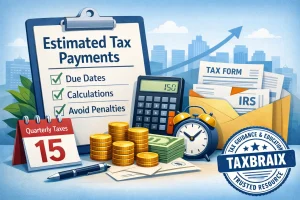
What Estimated Tax Payments Are
For many people, this happens invisibly through paycheck withholding. For others, especially those with self-employment income or uneven income sources, withholding is incomplete or does not exist at all. In those cases, estimated tax payments fill the gap.
Estimated tax payments commonly apply when income comes from:
- Self-employment or freelance work
- Small business or pass-through income
- Rental income
- Investment income
- Side gigs or contract work
In simple terms, estimated tax payments are how taxpayers prepay tax when no one else is doing it for them.
Table of Contents
How Estimated Tax Differs From Withholding
Withholding and estimated tax serve the same purpose, but they work differently.
- Withholding is automatic and tied to wages or certain payments
- Estimated tax is manual and based on projected income
Withholding is generally more forgiving. If too little is withheld early in the year, later withholding can often make up the difference. Estimated tax payments, by contrast, are evaluated by when they are made. Missing early payments can matter even if the total tax is eventually paid.
This timing difference is why estimated tax is closely connected to underpayment penalties, even when no balance is owed at filing.
Why Estimated Tax Payments Matter
Estimated tax payments are not about precision. They are about reasonable, timely effort.
They matter because:
- Paying tax only at filing time may be too late
- Penalties are based on payment timing, not just totals
- Interest can accrue even when tax is eventually paid
- Filing on time does not eliminate underpayment penalties
Many taxpayers first learn about estimated tax after receiving a penalty notice, not when the obligation first arises.
Common Situations Where Estimated Tax Applies
Estimated tax payments often become relevant when:
- Someone starts self-employment or freelance work
- A side business begins to generate income
- Investment or rental income increases
- Withholding no longer reflects actual income
- Income becomes irregular or seasonal
These changes can happen gradually. In many cases, estimated tax obligations exist for months or years before they are recognized.
Estimated Tax Is About Timing, Not Punishment
A key point to understand early is that estimated tax payments are not a penalty system. They are a payment timing system.
When estimated payments are missed:
- Penalties apply because tax was paid late
- Interest applies because tax remained unpaid
- The issue is timing, not wrongdoing
This is why estimated tax issues often affect otherwise compliant taxpayers.
The Internal Revenue Service administers estimated tax rules based on statutory timing requirements. While dollar amounts and thresholds can change, the underlying structure remains consistent.
Why Estimated Tax Payments Exist
Estimated tax payments exist because the tax system is built around a pay-as-you-go model. Tax is expected to be paid as income is earned throughout the year, not accumulated and paid all at once after the year ends.
When income is subject to withholding, this happens automatically. When it is not, estimated tax payments are how the system maintains that same timing.
The Pay-As-You-Go Structure
Under the pay-as-you-go system:
- Tax is due throughout the year as income is earned
- Payment timing matters just as much as total tax owed
- Waiting until filing time is often considered too late
This structure applies regardless of how income is earned. Whether income comes from wages, business activity, or investments, the expectation is the same: tax should be paid during the year.
Estimated tax payments exist to enforce this timing when withholding does not apply or is insufficient.
Why Withholding Alone Is Not Enough
Withholding works well for traditional employment because:
- Income is predictable
- Payments are regular
- Employers handle calculations and remittance
Many types of income do not fit this model. Self-employment income, rental income, and investment income often:
- Fluctuate throughout the year
- Have no automatic withholding
- Change quickly as circumstances evolve
Without estimated tax payments, taxpayers with these income types would consistently pay tax later than required, even if they paid in full at filing.
Fairness and System Balance
Estimated tax payments also exist to maintain equity across taxpayers.
If some taxpayers paid tax throughout the year while others waited until filing, the system would:
- Favor those with non-withheld income
- Create uneven cash flow for tax authorities
- Shift compliance burdens unfairly
Estimated payments ensure that taxpayers with different income structures are held to similar timing standards.
Relationship to Underpayment Penalties
Estimated tax payments are closely tied to underpayment penalties, but the payments themselves are not penalties.
Underpayment penalties apply when:
- Required payments were not made on time
- Too little tax was paid during the year
- Payment timing fell short of required thresholds
These penalties are essentially a charge for paying tax late, not a punishment for earning certain types of income.
This is why a taxpayer can:
- File on time
- Pay the full balance at filing
- Still owe an underpayment penalty
The issue is when the tax was paid, not whether it was paid.
Why Estimated Payments Are Often Misunderstood
Estimated tax payments are frequently misunderstood because:
- The rules focus on timing, not totals
- Obligations are not always obvious when income starts
- Penalties are assessed after the year ends
- Notices arrive long after the first missed payment
Many taxpayers do not realize estimated tax is required until they receive a penalty notice, even though the obligation existed earlier.
Federal Administration of Estimated Tax Rules
The Internal Revenue Service administers estimated tax rules based on statutory timing requirements. While payment thresholds and penalty calculations can change, the underlying principle remains consistent: tax should be paid as income is earned.
States apply similar concepts at the state level, often with their own estimated tax requirements and penalties.
Why This Matters for Compliance
Understanding why estimated tax payments exist helps shift the focus from frustration to planning.
Estimated tax is:
- A timing requirement, not a judgment
- A tool for compliance, not punishment
- A system designed to mirror withholding
When understood early, estimated payments become manageable. When ignored, they often lead to penalties and interest that feel unexpected.
The next section explains who is required to make estimated tax payments, focusing on the income types and situations where withholding does not adequately cover tax obligations.
Who Is Required to Make Estimated Tax Payments
Estimated tax payments are required when withholding does not cover enough tax during the year. This requirement is based on how income is earned and paid, not on employment status alone.
Many taxpayers who have never made estimated payments before become subject to them after a change in income, work structure, or investment activity.
Self-Employed Individuals
Self-employed individuals are the group most commonly required to make estimated tax payments.
Because there is:
- No employer withholding income tax
- No withholding for self-employment tax
- No automatic adjustment during the year
Self-employment income almost always requires estimated payments.
This includes income from:
- Freelance or contract work
- Sole proprietorships
- Gig or platform-based work
- Consulting and professional services
Even relatively modest self-employment income can trigger estimated tax obligations, especially when it represents a taxpayer’s primary income source.
Individuals With Income Not Subject to Withholding
Estimated tax payments are also commonly required for individuals who receive income that is not subject to regular withholding.
Examples include:
- Interest and dividend income
- Rental income
- Royalties
- Capital gains not offset by withholding
- Certain retirement or distribution income
When this income becomes meaningful relative to total income, withholding from other sources may no longer be sufficient to cover total tax owed.
Small Business Owners and Pass-Through Income
Owners of small businesses structured as pass-through entities often need to make estimated tax payments at the individual level.
This applies when business income:
- Flows through to the owner’s personal return
- Is not subject to payroll withholding
- Varies throughout the year
Even when a business is profitable on paper but cash flow is uneven, estimated payments may still be required based on taxable income.
Taxpayers With Multiple Income Sources
Estimated tax obligations often arise when income becomes more complex rather than larger.
This is common when:
- Wage income is combined with self-employment income
- Investments generate unexpected gains
- Side income grows gradually
- Withholding settings are not updated
In these cases, withholding may cover part of the tax, but estimated payments are needed to close the gap.
Why the Requirement Is Not Always Obvious
Many taxpayers who are required to make estimated payments do not realize it right away because:
- Income increases gradually
- Prior-year withholding was sufficient
- Penalties are assessed after the year ends
- Notices arrive long after the first missed payment
Estimated tax requirements often exist quietly before they become visible through penalties.
Federal Determination of Estimated Tax Requirements
The Internal Revenue Service determines estimated tax requirements based on statutory thresholds and payment timing rules. These rules focus on:
- Total tax liability
- Amount paid during the year
- When payments were made
They do not depend on whether income felt predictable or whether the taxpayer intended to pay later.
State Estimated Tax Considerations
In addition to federal estimated tax, many states impose their own estimated payment requirements. These often apply when:
- Federal estimated payments are required
- Income is earned in multiple states
- State withholding is insufficient
State estimated tax is frequently overlooked, which can lead to separate penalties and interest.
When Estimated Tax Applies Unexpectedly
Estimated tax payments often become required after:
- A job change or loss
- Starting or expanding a side business
- Receiving a large one-time payment
- Selling assets or investments
Because these events are not always planned, estimated tax obligations are often discovered after the fact.
Understanding who is required to make estimated tax payments helps taxpayers recognize obligations early, before penalties apply. The next section explains when estimated tax payments are not required, and why “not required” does not always mean “not beneficial.”
When Estimated Tax Payments Are Not Required
Not every taxpayer is required to make estimated tax payments. In some situations, withholding or low overall tax liability is enough to satisfy pay-as-you-go requirements. However, it is important to understand why estimated payments are not required in these cases, and why that status can change quickly.
When Withholding Fully Covers Tax
Estimated tax payments are generally not required when withholding during the year is sufficient to cover total tax owed.
This often applies when:
- All income comes from wages
- Withholding settings are accurate
- No significant additional income exists
In these cases, withholding functions as a built-in estimated payment system. As long as enough tax is withheld throughout the year, no separate estimated payments are needed.
However, this relies on withholding being kept up to date. When income changes but withholding does not, estimated tax obligations can arise unexpectedly.
Low or Minimal Tax Liability
Estimated tax payments may not be required when total tax liability is relatively low.
This can occur when:
- Income is modest
- Credits significantly reduce tax
- Deductions offset most income
In these situations, required payments during the year may fall below thresholds that trigger penalties. Still, filing obligations usually remain, even when estimated payments are not required.
First-Year Income Situations
Taxpayers with new income sources sometimes fall outside estimated tax requirements in the first year, depending on how much tax is ultimately owed and how payments are structured.
This can happen when:
- Self-employment begins late in the year
- Business income is minimal at startup
- Prior-year tax liability was very low or zero
While penalties may not apply immediately, relying on first-year circumstances can be risky if income grows faster than expected.
When Prior-Year Payments Provide Coverage
In some cases, taxpayers are not required to make estimated payments because prior-year payments or withholding already satisfy required thresholds.
This often applies when:
- Income is stable year over year
- Withholding patterns have not changed
- Prior-year tax liability was fully covered
This situation can change quickly if income increases, withholding decreases, or new income sources appear.
“Not Required” Does Not Mean “Not Helpful”
A critical distinction is that not being required to make estimated payments does not mean making them is a bad idea.
Estimated payments can still be helpful when:
- Income is increasing during the year
- Withholding feels borderline
- Cash flow allows for proactive payments
- Taxpayers want to avoid surprises at filing
In many cases, voluntary estimated payments reduce stress and prevent unexpected balances due.
Why Estimated Tax Status Can Change Mid-Year
Estimated tax requirements are not fixed for life. They often change when:
- Income sources shift
- Self-employment begins or expands
- Investment income increases
- Withholding is reduced
Because the rules are tied to current-year activity, a taxpayer who was not required to make estimated payments last year may be required to do so this year.
Federal Rules and Changing Circumstances
The Internal Revenue Service evaluates estimated tax requirements based on current-year liability and payment timing, not on past habits or expectations. This is why reviewing estimated tax needs periodically is important, especially after income changes.
Understanding when estimated tax payments are not required helps prevent unnecessary payments, but it should not lead to complacency. The next section explains how estimated tax payments are calculated, and why estimates do not need to be perfect to be effective.
How Estimated Tax Payments Are Calculated
Estimated tax payments are based on projected annual tax, not on exact precision. The goal is to pay a reasonable amount of tax throughout the year so that payment timing aligns with income as it is earned.
Many taxpayers delay estimated payments because they believe calculations must be exact. In reality, the system allows for reasonable estimates, adjustments, and corrections over time.
Estimating Total Annual Income
The first step in calculating estimated tax is estimating total income for the year.
This includes:
- Expected self-employment or business income
- Wage income not fully covered by withholding
- Investment income
- Rental or other non-withheld income
Estimates can be based on:
- Prior-year income as a starting point
- Year-to-date income trends
- Known contracts or recurring revenue
- Conservative assumptions when income is uncertain
Income does not need to be predicted perfectly. Estimates can be updated as the year progresses.
Accounting for Deductions and Adjustments
After estimating gross income, the next step is accounting for deductions and adjustments that reduce taxable income.
Common examples include:
- Business expenses
- Retirement contributions
- Health insurance deductions for self-employed individuals
- Standard or itemized deductions
For estimated tax purposes, it is usually better to:
- Use realistic but cautious assumptions
- Avoid aggressive deductions that may not materialize
- Focus on consistency rather than optimization
Overestimating deductions can lead to underpayment penalties later.
Applying Tax Rates
Once taxable income is estimated, tax rates are applied to calculate expected tax liability.
Key points to keep in mind:
- Tax rates are progressive, not flat
- Only income within each bracket is taxed at that rate
- Effective tax rates are usually lower than top marginal rates
For estimated payments, exact bracket placement is less important than paying enough overall to meet timing requirements.
Including Self-Employment Tax When Applicable
For self-employed individuals, estimated tax must account for:
- Income tax, and
- Self-employment tax
This is one of the most common reasons estimated payments feel larger than expected. Unlike wage earners, self-employed taxpayers are responsible for both sides of payroll-related taxes.
Failing to include self-employment tax in estimates is a frequent cause of underpayment penalties.
Reducing the Estimate by Withholding and Credits
Estimated tax payments are only meant to cover what withholding and credits do not.
When calculating estimated payments:
- Subtract expected withholding from wages or other sources
- Account for known credits that reduce tax
This coordination prevents overpaying while still meeting timing requirements.
Dividing the Annual Estimate Into Payments
Once total estimated tax is calculated, it is divided into periodic payments, typically four.
These payments:
- Represent installments toward the annual tax
- Are evaluated based on when they are made
- Do not need to be identical if income is uneven
Missing early payments matters more than missing later ones, because timing affects penalties.
Why Estimates Do Not Need to Be Perfect
Estimated tax is designed around good-faith effort, not exact forecasting.
Mistakes are common because:
- Income changes during the year
- Expenses fluctuate
- One-time events occur
The system allows taxpayers to:
- Adjust estimates mid-year
- Make catch-up payments
- Correct over- or under-estimates
The key is responding when income changes, not locking into an outdated estimate.
Federal Guidance on Estimated Calculations
The Internal Revenue Service bases estimated tax requirements on:
- Total tax liability
- Amount paid during the year
- Timing of payments
The emphasis is on when and how much was paid, not on whether the estimate was exact.
Understanding how estimated tax payments are calculated helps reduce fear around the process. The next section explains payment timing and due dates, and why estimated tax payments are structured quarterly rather than monthly.
Payment Timing and Due Dates
Estimated tax payments are structured around when tax is paid, not just how much is paid. Timing is central to how estimated tax works and is one of the most common sources of confusion and penalties.
Understanding the payment schedule helps taxpayers avoid underpayment penalties even when income is uneven or unpredictable.
The Quarterly Payment Structure
Estimated tax payments are typically made four times a year, often referred to as quarterly payments. These payments represent installments toward the total tax expected for the year.
Although called “quarterly,” the payments are not evenly spaced across the calendar year. This structure reflects how income is assumed to be earned over time, not equal calendar quarters.
The four payment periods generally cover:
- Early-year income
- Mid-year income
- Late-summer income
- End-of-year income
Each payment is evaluated independently based on timing.
Why Payments Are Not Evenly Spaced
One common misconception is assuming estimated payments are due every three months. In reality, the schedule is uneven.
This matters because:
- Missing early payments can trigger penalties
- Catching up later does not always eliminate penalties
- Payments are assessed by period, not cumulatively
The uneven schedule often surprises taxpayers who plan payments evenly throughout the year without checking due dates.
What Happens When Due Dates Fall on Weekends or Holidays
When an estimated tax due date falls on a weekend or holiday, the deadline typically moves to the next business day.
This flexibility helps with logistics, but it does not change:
- Which payment period the payment applies to
- How underpayment penalties are calculated
Waiting beyond the adjusted deadline can still trigger penalties.
Timing Matters More Than Total Paid
One of the most important principles of estimated tax is that timing matters more than totals.
This means:
- Paying the full annual tax late does not replace earlier payments
- Missing early payments can trigger penalties even if later payments are large
- Overpaying later does not erase underpayments from earlier periods
Each payment period is evaluated separately.
Uneven or Seasonal Income Considerations
Many taxpayers earn income unevenly throughout the year. This is common for:
- Self-employed individuals
- Seasonal businesses
- Commission-based work
The estimated tax system allows some flexibility for uneven income, but it requires active adjustment.
Waiting until income stabilizes can result in:
- Missed early payment obligations
- Penalties even when income was low initially
Tracking income by period helps align payments with actual earnings.
Catch-Up Payments and Their Limits
Catch-up payments can reduce future penalties, but they have limits.
Catch-up payments:
- Reduce the balance subject to future penalties
- Do not always eliminate penalties for earlier periods
- Are more effective when made sooner rather than later
The longer a period remains unpaid, the more likely penalties and tax interest will apply.
Federal Evaluation of Payment Timing
The Internal Revenue Service evaluates estimated tax compliance based on:
- How much was paid
- When it was paid
- Which period it applied to
This is why payment dates and application periods matter just as much as dollar amounts.
Why Payment Timing Is Often Overlooked
Payment timing is often overlooked because:
- Estimated tax penalties are assessed after the year ends
- Notices arrive long after missed payments
- Withholding masks timing issues for many taxpayers
By the time penalties appear, the opportunity to fix early timing issues has passed.
Understanding payment timing and due dates is essential to managing estimated tax successfully. The next section explains safe harbor rules, which can reduce penalty risk even when estimated payments are imperfect.
Safe Harbor Rules and How They Work
Safe harbor rules exist to reduce or eliminate underpayment penalties when estimated tax payments are not perfectly aligned with actual income. They do not eliminate the obligation to pay tax, but they provide protection against penalties when certain payment thresholds are met.
Safe harbors are especially important for taxpayers with fluctuating income or income that is difficult to predict.
What Safe Harbor Rules Are
Safe harbor rules set minimum payment benchmarks that, if met, generally protect taxpayers from underpayment penalties, even if the final tax owed is higher.
The key idea is this:
If you paid enough during the year based on specific standards, penalties usually do not apply, even if your estimate was not exact.
Safe harbors focus on:
- How much tax was paid during the year
- When it was paid
- How current-year payments compare to prior-year tax
They do not change how much tax you ultimately owe.
Why Safe Harbors Exist
Safe harbors exist because income is not always predictable. Without them:
- Any estimation error could trigger penalties
- Taxpayers with variable income would face constant risk
- Planning would be impractical for many situations
Safe harbors provide certainty, allowing taxpayers to plan payments without perfect forecasting.
Common Safe Harbor Approaches
Safe harbor protection is typically based on one of two approaches:
Paying based on prior-year tax
Paying a sufficient percentage of the prior year’s total tax liability during the current year can protect against penalties, regardless of current-year income changes.
Paying based on current-year tax
Paying a sufficient portion of the current year’s tax liability as income is earned can also qualify, even when income fluctuates.
The key difference is predictability:
- Prior-year safe harbors are easier to plan
- Current-year safe harbors adjust better to income changes
What Safe Harbors Do Not Do
Safe harbors are often misunderstood. They do not:
- Reduce the total tax owed
- Eliminate the need to file a return
- Stop tax interest from accruing on unpaid balances
- Replace estimated tax payments entirely
They only address penalty exposure, not payment obligations.
Safe Harbors and Uneven Income
Safe harbors are especially useful for taxpayers with:
- Seasonal income
- Commission-based earnings
- Self-employment income that varies month to month
In these cases, relying on prior-year tax can provide stability when current-year income is unpredictable.
However, relying on prior-year amounts without monitoring income growth can still result in:
- Large balances due at filing
- Significant interest accrual
Safe harbors reduce penalties, not cash flow impact.
Why Safe Harbors Are Often Misapplied
Safe harbor rules are frequently misapplied because:
- Thresholds change year to year
- Income changes faster than planning assumptions
- Taxpayers assume “any payment” qualifies
- State safe harbor rules differ from federal rules
Using a safe harbor incorrectly can create a false sense of security.
Federal Administration of Safe Harbor Rules
The Internal Revenue Service administers safe harbor rules through statutory payment thresholds and timing requirements. These rules are evaluated after the year ends, based on actual payments made.
This is why:
- Safe harbor protection cannot be confirmed mid-year
- Payment timing must still align with required periods
- Documentation of payments matters
Safe Harbors as a Planning Tool
Safe harbors are most effective when used as part of a broader plan.
They work best when taxpayers:
- Review prior-year tax early
- Monitor current-year income trends
- Adjust payments when income grows significantly
- Use safe harbors intentionally, not by accident
When used correctly, safe harbors reduce stress and penalty risk, even in complex income situations.
The next section explains estimated payments versus withholding, and why adjusting withholding is sometimes a better alternative than making separate estimated tax payments.
Estimated Payments vs Withholding
Estimated tax payments and withholding serve the same purpose: prepaying tax during the year. The difference lies in how the tax is paid, how forgiving the system is, and how mistakes are treated.
Understanding this distinction helps taxpayers choose the most practical and lowest-risk way to meet their payment obligations.
How Withholding Works
Withholding is tax taken out automatically from certain payments, most commonly wages.
Key characteristics of withholding include:
- It is handled by an employer or payer
- Payments are spread evenly across pay periods
- Adjustments later in the year can often fix earlier shortfalls
Withholding is generally more forgiving because the system treats withheld tax as if it were paid evenly throughout the year, even if more is withheld later.
This flexibility is one reason withholding errors are less likely to trigger underpayment penalties.
How Estimated Tax Payments Work Differently
Estimated tax payments are manual and period-specific.
Unlike withholding:
- Payments must be made intentionally
- Each payment period is evaluated separately
- Missing early payments matters more than missing later ones
Estimated payments are not automatically smoothed across the year. A late payment is late, even if the total tax is eventually paid.
This difference is why estimated tax payments are more closely tied to underpayment penalties.
Why Withholding Is Often Safer
For many taxpayers, adjusting withholding is a lower-risk alternative to making estimated payments.
Withholding is often safer because:
- It is treated as paid evenly across the year
- It automatically adapts to pay frequency
- It reduces the risk of timing-related penalties
This can be especially helpful when income is predictable but withholding is simply too low.
When Adjusting Withholding Makes Sense
Adjusting withholding may be preferable when:
- Wage income is present
- Additional income is modest or predictable
- Estimated payments feel complex or easy to forget
In these cases, increasing withholding can replace or reduce the need for estimated payments.
For example, someone with both wage income and self-employment income may choose to:
- Increase wage withholding to cover self-employment tax, rather than
- Make separate quarterly estimated payments
This approach consolidates payment timing and reduces penalty risk.
When Estimated Payments Are Still Necessary
Estimated tax payments are often unavoidable when:
- There is no wage income
- Income is irregular or seasonal
- Business income fluctuates significantly
- Withholding cannot be adjusted enough
Self-employed individuals and many small business owners fall into this category because there is no payer responsible for withholding tax.
Combining Withholding and Estimated Payments
Many taxpayers use a hybrid approach, combining withholding and estimated payments.
This approach may involve:
- Using withholding to cover baseline tax
- Using estimated payments to address spikes in income
- Adjusting both as income changes during the year
This flexibility allows taxpayers to match payment methods to income sources.
Common Mistakes When Choosing Between the Two
Common mistakes include:
- Assuming estimated payments are required simply because income is non-wage
- Ignoring withholding as a planning tool
- Making estimated payments when withholding could have solved the issue
- Forgetting that withholding adjustments apply prospectively, not retroactively
Choosing the wrong approach can increase complexity without improving compliance.
Federal Treatment of Withholding vs Estimated Tax
The Internal Revenue Service treats withholding and estimated tax differently for penalty purposes. Withholding is generally credited evenly throughout the year, while estimated payments are credited when made.
This difference is why:
- Late-year withholding adjustments can reduce penalties
- Late-year estimated payments often cannot
Understanding this distinction helps taxpayers plan payments more strategically.
Choosing the Right Tool
Neither withholding nor estimated payments are inherently better. The right approach depends on:
- Income sources
- Predictability of earnings
- Administrative preference
- Risk tolerance for penalties
Using the simplest method that meets payment timing requirements is usually the best strategy.
The next section explains how to actually make estimated tax payments, including payment methods and common application mistakes that can undermine otherwise correct planning.
How to Make Estimated Tax Payments
Once estimated tax payments are required, the next challenge is making sure payments are submitted correctly. Many estimated tax problems are not caused by missing payments entirely, but by payments being misapplied, mistimed, or credited to the wrong period.
Understanding the mechanics helps ensure that payments actually count toward compliance.
Accepted Payment Methods
Estimated tax payments can be made using several approved methods. The method itself is less important than accuracy and timing.
Common methods include:
- Electronic payments through authorized payment systems
- Bank transfers
- Mailed payments with proper identification
Electronic methods are generally preferred because they:
- Provide immediate confirmation
- Reduce processing delays
- Lower the risk of misapplication
Regardless of method, payments must be made on or before the due date to count for the intended period.
Applying Payments to the Correct Tax Year and Period
One of the most common estimated tax mistakes is applying a payment to the wrong tax year or payment period.
Each estimated payment must be:
- Applied to the correct tax year
- Designated for the correct quarterly period
If a payment is applied incorrectly:
- It may not count toward the intended obligation
- Underpayment penalties may still apply
- Corrections can take time
This issue often arises when:
- Payments are made late in the year
- Multiple years are involved
- Payments are submitted without clear designation
Timing Is More Important Than Method
From a compliance standpoint, when a payment is made matters more than how it is made.
Key timing points include:
- Payments must be credited by the due date
- Mailing delays can cause late credit
- Processing time varies by method
Relying on last-minute payments increases the risk of penalties, even when the intent was correct.
Making Payments When Income Is Uneven
For taxpayers with uneven income, estimated payments may need to be:
- Adjusted during the year
- Increased after high-income periods
- Reduced when income slows
Payments do not have to be equal. What matters is that enough tax is paid during each required period.
Waiting until year-end to reconcile uneven income often leads to penalties that could have been reduced with earlier adjustments.
Coordinating Federal and State Payments
Estimated tax payments often need to be made at both the federal and state level.
Important considerations include:
- Separate payment systems
- Separate due dates
- Separate penalty calculations
A payment made to one authority does not satisfy obligations to the other. Each must be handled independently.
Recordkeeping and Confirmation
Keeping records of estimated payments is critical.
Best practices include:
- Saving payment confirmations
- Tracking payment dates and amounts
- Recording which period each payment applied to
These records are often needed when:
- Reconciling payments on a tax return
- Responding to a notice
- Verifying that penalties were calculated correctly
Common Payment Mistakes
Some of the most common mistakes include:
- Missing early-year payments
- Applying payments to the wrong year
- Forgetting state estimated payments
- Assuming a payment “will be applied automatically”
These mistakes are easy to make and often only surface after penalties are assessed.
Federal Administration of Estimated Tax Payments
The Internal Revenue Service credits estimated tax payments based on payment date, amount, and designated period. Payments that are late or misapplied are treated as underpayments, even if the total tax is eventually paid.
This is why clarity and timing matter more than perfection.
Why Correct Payment Execution Matters
Estimated tax compliance is not just about knowing what to pay. It is about making sure payments are:
- Timely
- Properly designated
- Documented
When payments are made correctly, estimated tax becomes a manageable routine. When they are not, penalties and interest often follow despite good intentions.
The next section explains how underpayment penalties relate to estimated tax, and why penalties can apply even when the full balance is paid at filing time.
Underpayment Penalties and Estimated Tax
Underpayment penalties are the primary consequence of missing or insufficient estimated tax payments. They apply when enough tax is not paid during the year, even if the full balance is paid later when the return is filed.
This is one of the most misunderstood parts of estimated tax because it feels counterintuitive to many taxpayers.
What Triggers an Underpayment Penalty
An underpayment penalty generally applies when:
- Too little tax was paid during the year, and
- Required payments were not made on time
The penalty is based on payment timing, not on whether tax was eventually paid.
This means a taxpayer can:
- File on time
- Pay the full balance at filing
- Still owe an underpayment penalty
The issue is not compliance at filing time. It is compliance during the year.
Why Paying at Filing Time Is Sometimes Too Late
Estimated tax operates on the assumption that income is earned throughout the year. When tax is paid only at filing:
- Early payment periods remain unpaid
- The system treats those periods as late
- A penalty is calculated for each affected period
This is why making one large payment at filing does not replace quarterly estimated payments.
How Underpayment Penalties Are Calculated
Underpayment penalties are calculated based on:
- How much tax should have been paid
- How much was actually paid
- When payments were made
The calculation is period-specific. Each payment period is evaluated separately, which is why:
- Missing early payments matters more
- Catch-up payments may not erase earlier penalties
- Uneven payment patterns can still trigger penalties
The penalty functions similarly to interest charged for paying tax late.
Interaction With Tax Interest
Underpayment penalties and tax interest often appear together, but they are separate charges.
- Underpayment penalties address timing failures
- Tax interest applies to unpaid balances
In some situations:
- The underpayment penalty reflects interest-like charges
- Additional tax interest may still apply if a balance remains unpaid
Together, they increase the total cost of delayed payment.
Why Penalties Are Assessed After the Year Ends
Many taxpayers are surprised to learn about underpayment penalties months after filing.
This happens because:
- The penalty is calculated after total tax is known
- Payment timing is evaluated retroactively
- Notices are issued only after processing
By the time the penalty appears, the opportunity to correct early-year timing has passed.
Safe Harbors and Penalty Protection
Safe harbor rules can protect against underpayment penalties when:
- Required thresholds are met
- Payments were made on time
- Prior-year or current-year standards were satisfied
Safe harbors do not eliminate tax owed, but they can eliminate the penalty even when income increases unexpectedly.
Misunderstanding safe harbors is one of the most common reasons taxpayers are surprised by penalties.
State Underpayment Penalties
Underpayment penalties often apply at the state level as well.
Important differences include:
- Different thresholds
- Different payment schedules
- Different penalty calculations
Resolving a federal underpayment penalty does not resolve state penalties. Each system must be addressed separately.
IRS Evaluation of Underpayment
The Internal Revenue Service evaluates underpayment penalties based on statutory formulas tied to payment timing. Intent, hardship, or surprise does not usually affect whether the penalty applies, though relief may sometimes be requested.
This is why proactive payment planning is far more effective than reactive fixes.
Why Understanding Penalties Changes Behavior
Once taxpayers understand that underpayment penalties are about timing, not blame, behavior often shifts.
Instead of asking:
- “Will I owe tax at filing?”
The better question becomes:
- “Have I paid enough tax during the year?”
That shift alone prevents most estimated tax penalties.
The next section explains estimated tax for self-employed individuals, where underpayment penalties are most common and where planning has the biggest impact.
Estimated Tax for Self-Employed Individuals
Self-employed individuals are the group most consistently affected by estimated tax requirements. Without an employer to withhold taxes automatically, self-employed taxpayers are responsible for managing both payment timing and payment amount on their own.
This is why estimated tax issues, including underpayment penalties, are especially common in self-employment situations.
Why Estimated Tax Is the Default for Self-Employment
When you are self-employed:
- No income tax is withheld from your earnings
- No payroll taxes are withheld on your behalf
- Income may fluctuate significantly throughout the year
As a result, estimated tax payments are not optional in most cases. They are the primary mechanism for meeting pay-as-you-go requirements.
This applies whether self-employment is:
- A full-time activity
- A side business
- Seasonal or project-based
Even part-time self-employment can trigger estimated tax obligations when income grows.
Accounting for Both Income Tax and Self-Employment Tax
One of the biggest surprises for new self-employed taxpayers is the size of estimated tax payments. This is usually because estimates must cover two separate components:
- Income tax, based on taxable income
- Self-employment tax, which replaces payroll taxes
Employees split payroll taxes with their employer. Self-employed individuals cover the full amount themselves. Failing to include self-employment tax in estimates is a common reason payments fall short.
Irregular Income and Planning Challenges
Self-employment income is often uneven. Clients pay late, projects end unexpectedly, and revenue can spike or drop without warning.
This creates challenges because:
- Estimated payments are based on timing, not hindsight
- Early-year income gaps do not automatically excuse missed payments
- Catch-up payments may not eliminate early penalties
Managing estimated tax with irregular income requires active monitoring, not a one-time calculation.
Business Expenses and Their Role in Estimates
Business expenses reduce taxable income, but they must be estimated carefully.
Common issues include:
- Overestimating expenses early in the year
- Assuming deductions that do not materialize
- Mixing personal and business spending
For estimated tax purposes, conservative expense estimates reduce the risk of underpayment penalties later.
Cash Flow vs Compliance Tension
Self-employed individuals often face a real tension between:
- Preserving cash flow for business needs, and
- Paying estimated tax on time
Delaying estimated payments may feel necessary, but it increases:
- Underpayment penalties
- Tax interest
- End-of-year cash strain
Even partial payments help reduce long-term cost.
Why Self-Employed Taxpayers Are Penalized More Often
Self-employed taxpayers are penalized more frequently not because they are less compliant, but because:
- There is no automatic withholding safety net
- Income changes quickly
- Estimated tax rules are timing-based
- Penalties are assessed after the year ends
By the time a penalty notice arrives, the opportunity to fix early payment timing has already passed.
Recordkeeping and Estimated Tax
Good recordkeeping makes estimated tax easier to manage.
Helpful practices include:
- Tracking income monthly
- Separating business and personal accounts
- Updating estimates when income changes
- Keeping a simple estimated tax log
These habits reduce guesswork and make adjustments easier.
Federal Oversight of Self-Employment Estimated Tax
The Internal Revenue Service evaluates estimated tax compliance for self-employed individuals using the same timing rules that apply to other taxpayers. There is no exception for income volatility unless specific relief provisions apply.
This is why planning matters more than perfection.
Why Estimated Tax Is a Core Self-Employment Skill
For self-employed individuals, estimated tax is not an edge case. It is a core part of staying compliant.
When managed proactively, estimated tax:
- Reduces penalty risk
- Improves cash flow predictability
- Prevents large year-end balances
- Makes income growth easier to handle
The next section explains estimated tax considerations for small businesses, where income flows through to owners and planning becomes more complex as operations expand.
Estimated Tax for Small Businesses
Estimated tax payments are not limited to solo freelancers. Small business owners are frequently required to make estimated payments at the individual level because business income often flows through to the owner’s personal tax return.
As businesses grow, estimated tax planning becomes more complex and more important.
How Small Business Income Triggers Estimated Tax
Many small businesses are structured so that income is taxed to the owner, not the business entity itself.
This commonly includes:
- Sole proprietorships
- Single-member LLCs
- Partnerships
- Certain pass-through entities
In these structures:
- The business does not pay income tax directly
- Profits flow through to the owner’s personal return
- No automatic withholding applies
As a result, estimated tax payments are usually required once the business becomes profitable.
Why Business Growth Changes Estimated Tax Needs
Estimated tax obligations often increase as a business grows, even if growth feels gradual.
This happens because:
- Profits increase faster than expected
- Expenses stabilize while revenue grows
- Cash flow improves but tax planning lags
Many business owners rely on early-year patterns that no longer apply once growth accelerates, leading to underpayment penalties later.
Profit vs Cash Flow Confusion
One of the most common issues for small businesses is the difference between profit and cash flow.
Estimated tax is based on taxable profit, not on:
- Cash currently in the bank
- Timing of customer payments
- Business reinvestment decisions
This can create situations where:
- A business is profitable on paper
- Cash is tied up in operations
- Estimated tax is still due
Failing to plan for this disconnect is a frequent cause of missed payments.
Owner Compensation and Estimated Tax
Small business owners often misunderstand how owner compensation affects estimated tax.
For example:
- Taking draws does not create withholding
- Leaving profits in the business does not eliminate tax
- Paying yourself irregularly does not change timing rules
Estimated tax is driven by taxable income, not by how or when money is withdrawn.
Multi-State Business Activity
Small businesses operating in more than one state face additional estimated tax complexity.
This can involve:
- Estimated payments to multiple states
- Different payment schedules
- Separate penalty calculations
Ignoring state estimated tax requirements is common and often results in penalties that surface long after federal issues are resolved.
Adjusting Estimates as the Business Evolves
Small businesses rarely have stable income year-round.
Estimated tax planning should adjust when:
- New clients are added
- Revenue increases significantly
- Expenses change materially
- Business models shift
Sticking with an outdated estimate is one of the most common small business mistakes.
Recordkeeping and Projection Discipline
Good estimated tax planning for small businesses depends on basic projection discipline, not advanced forecasting.
Helpful practices include:
- Reviewing profit monthly or quarterly
- Separating tax savings from operating cash
- Updating estimates after strong revenue periods
- Tracking estimated payments alongside business performance
These habits make estimated tax predictable instead of reactive.
Federal Treatment of Small Business Estimated Tax
The Internal Revenue Service applies estimated tax rules to small business owners based on individual tax liability, not business size or intent. There is no exemption for reinvestment, growth stage, or administrative burden.
This is why estimated tax planning must grow with the business.
Why Estimated Tax Is a Business Planning Issue
For small businesses, estimated tax is not just a compliance task. It is a cash flow and planning issue.
Handled well, estimated tax:
- Prevents surprise balances
- Reduces penalties and interest
- Makes growth easier to manage
- Improves financial clarity
Handled poorly, it often becomes a recurring source of stress and penalties.
The next section explains how and when to adjust estimated payments during the year, especially when income is uneven or changes unexpectedly.
Adjusting Estimated Payments During the Year
Estimated tax payments are not meant to be set once and forgotten. They are designed to be adjusted as income changes. In practice, this flexibility is one of the most important features of the estimated tax system, especially for individuals, self-employed taxpayers, and small businesses with uneven or unpredictable income.
Failing to adjust estimates is one of the most common reasons underpayment penalties occur.
Why Adjustments Are Often Necessary
Income rarely follows a straight line. Estimated payments often need to be adjusted when:
- Revenue increases or decreases significantly
- New income sources appear
- Business expenses change materially
- One-time income events occur
- Work patterns shift mid-year
An estimate that was reasonable in January may be inaccurate by June.
Responding to Income Increases
When income increases, estimated payments often need to increase as well.
Common situations include:
- A strong business quarter
- New clients or contracts
- Higher-than-expected investment gains
- Expanded self-employment activity
Failing to adjust after an increase can result in:
- Underpayment penalties for later periods
- A large balance due at filing
- Accrued tax interest
Increasing estimated payments after income increases is usually more effective than waiting until year-end.
Handling Income Decreases or Slow Periods
Estimated payments can also be adjusted downward when income drops.
This may be appropriate when:
- Work becomes seasonal
- A business experiences a slowdown
- Contracts end earlier than expected
- Expenses increase unexpectedly
However, reducing payments too aggressively can backfire if income rebounds later in the year. Conservative adjustments reduce risk.
Uneven and Seasonal Income Strategies
For taxpayers with uneven income, estimated tax planning requires period-based thinking.
Helpful strategies include:
- Reviewing income before each payment period
- Making larger payments after high-income periods
- Avoiding reliance on year-end catch-up payments
Waiting until income stabilizes often leads to missed early payment obligations that cannot be fully corrected later.
Catch-Up Payments and Their Limits
Catch-up payments can help, but they have limits.
Catch-up payments:
- Reduce penalties going forward
- Do not always erase penalties from earlier periods
- Are more effective when made sooner
The longer a payment period remains underpaid, the more likely penalties and tax interest will apply.
Adjustments vs Safe Harbor Planning
Some taxpayers rely on safe harbor rules to avoid frequent adjustments. This approach can work, but it has trade-offs.
Relying on safe harbors:
- Reduces penalty risk
- May result in large balances due at filing
- Does not reduce tax interest on unpaid balances
For growing income, combining safe harbor planning with periodic adjustments often produces better results.
Tracking Income to Support Adjustments
Adjusting estimates requires visibility into income.
Helpful practices include:
- Monthly or quarterly income reviews
- Separating personal and business accounts
- Tracking taxable income, not just cash flow
Even simple tracking is usually sufficient to make reasonable adjustments.
Federal Perspective on Adjustments
The Internal Revenue Service evaluates estimated tax compliance based on actual payments made and when they were made, not on whether estimates were updated formally. Adjustments are allowed, but they must be reflected in timely payments.
There is no penalty for adjusting estimates. Penalties arise only when payments fall short.
Why Adjustments Reduce Stress
Taxpayers who adjust estimated payments during the year typically experience:
- Fewer penalties
- Smaller balances due at filing
- More predictable cash flow
- Less year-end pressure
Estimated tax works best as a living plan, not a fixed calculation.
The next section explains common estimated tax mistakes, including planning assumptions and behaviors that frequently lead to penalties even when taxpayers are making payments.
Common Estimated Tax Mistakes
Estimated tax problems are rarely caused by a lack of effort. Most issues arise from reasonable assumptions that don’t match how the rules actually work. Because penalties are assessed later, mistakes often go unnoticed until after the year has ended.
Understanding these common errors helps prevent avoidable penalties and interest.
Waiting Until Filing Time to Pay
One of the most frequent mistakes is assuming that paying the full balance at filing is enough.
This approach fails because:
- Estimated tax is about when tax is paid
- Early payment periods remain unpaid
- Underpayment penalties are calculated by period
Paying everything at filing may satisfy the balance, but it does not fix missed timing during the year.
Missing Early-Year Payments
Early estimated payments matter more than many taxpayers realize.
Common reasons early payments are missed include:
- Income starting slowly at the beginning of the year
- Waiting to “see how the year goes”
- Assuming later payments will make up the difference
When early payments are missed, penalties can apply even if later payments are large.
Over-Relying on Prior-Year Results
Using prior-year tax as a baseline is common and often reasonable. Problems arise when income increases and estimates are not adjusted.
This often happens when:
- A business grows faster than expected
- Self-employment income expands mid-year
- Investment income spikes unexpectedly
Safe harbor rules can reduce penalties, but they do not reduce the final balance due or tax interest on unpaid amounts.
Ignoring State Estimated Tax Requirements
Many taxpayers focus only on federal estimated tax and forget that states often require estimated payments as well.
This leads to:
- Separate state underpayment penalties
- State tax interest accruing quietly
- Notices arriving years later
State estimated tax rules are similar in concept but differ in thresholds, timing, and enforcement.
Assuming Income Volatility Excuses Missed Payments
Income volatility is common, but it does not automatically excuse missed estimated payments.
Mistakes include:
- Assuming low income early in the year eliminates early obligations
- Waiting until income stabilizes before paying
- Relying on catch-up payments too late
The estimated tax system allows adjustment, but it still expects period-based payments.
Forgetting to Include All Tax Components
Another common error is estimating only income tax and forgetting other components.
This often affects:
- Self-employed individuals who omit self-employment tax
- Taxpayers with additional surtaxes or add-ons
- Small business owners focused only on cash flow
Leaving out required components almost always leads to underpayment.
Misapplying or Mislabeling Payments
Payments that are:
- Applied to the wrong tax year
- Applied to the wrong period
- Sent without proper designation
May not count toward estimated tax obligations at all.
This can result in penalties even when money was actually paid.
Assuming One Good Year Means No Future Risk
Estimated tax requirements can change quickly.
A taxpayer who did not need estimated payments last year may need them this year due to:
- New income sources
- Business expansion
- Changes in withholding
- Investment gains
Assuming last year’s approach still works is a frequent cause of surprise penalties.
Waiting for a Notice Before Acting
Many taxpayers wait until a notice arrives before addressing estimated tax issues.
By then:
- Penalties have already accrued
- Interest may be building
- Early payment opportunities are gone
The Internal Revenue Service assesses underpayment penalties after the year ends, which is why proactive action is far more effective than reactive fixes.
Why These Mistakes Are So Common
These mistakes persist because:
- Estimated tax penalties are delayed
- Rules focus on timing, not totals
- Withholding hides issues for many years
- Income changes faster than planning habits
Recognizing these patterns helps taxpayers correct course earlier.
Avoiding these common mistakes does not require perfect forecasting. It requires awareness, periodic review, and timely adjustment.
The next section explains estimated tax at the state level, including why state estimated payments are often overlooked and how they differ from federal requirements.
Estimated Tax at the State Level
Estimated tax obligations do not stop at the federal level. Many states require estimated tax payments as well, and these requirements are often overlooked until penalties and interest appear. State estimated tax follows similar principles to federal estimated tax, but the details vary widely.
Ignoring state estimated tax is one of the most common reasons taxpayers face unexpected state penalties years later.
Why States Require Estimated Tax Payments
States also operate under a pay-as-you-go framework. When state income tax applies and withholding is insufficient, states expect tax to be paid during the year rather than entirely at filing time.
State estimated tax exists for the same reasons as federal estimated tax:
- To match tax payments with income timing
- To prevent large balances due at filing
- To apply penalties when payments are late
If a state taxes your income and withholding does not cover the liability, estimated payments are often required.
When State Estimated Tax Is Commonly Required
State estimated tax obligations commonly arise when:
- Federal estimated tax payments are required
- Income is not subject to state withholding
- Self-employment income is present
- Business or pass-through income flows to owners
- Investment or rental income increases
If you owe state income tax and no one is withholding enough on your behalf, state estimated payments are usually part of the picture.
Differences Between Federal and State Rules
While the concepts are similar, state estimated tax rules are not identical to federal rules.
Key differences may include:
- Different payment thresholds
- Different due dates
- Different penalty calculations
- Different safe harbor rules
- Different interest rates
A payment pattern that avoids federal underpayment penalties may still trigger state penalties if state-specific rules are not met.
Multi-State Income Complications
Taxpayers with income earned in more than one state face additional complexity.
This can involve:
- Estimated payments to multiple states
- Separate calculations for each state
- Different payment schedules
- Separate penalty exposure in each jurisdiction
Because states often identify issues later using federal income data reported through the Internal Revenue Service, state penalties may appear long after federal issues seem resolved.
Why State Estimated Tax Is Often Missed
State estimated tax is frequently overlooked because:
- Federal tax receives more attention
- Withholding masks state obligations
- State notices arrive later
- Multi-state income complicates enforcement
Many taxpayers assume that handling federal estimated tax automatically covers state obligations. It does not.
State Penalties and Interest Add Up Quickly
State underpayment penalties and interest often:
- Accrue separately from federal charges
- Continue quietly for years
- Surface unexpectedly through notices or offsets
Because state interest rates and penalty structures vary, costs can grow faster than expected.
Coordinating Federal and State Estimated Payments
Effective planning requires coordination, not duplication.
Best practices include:
- Reviewing both federal and state estimated needs together
- Aligning payment timing where possible
- Tracking payments separately for each authority
- Avoiding assumptions that one payment covers all obligations
Even when amounts differ, coordinating timing reduces oversight risk.
Why State Estimated Tax Matters Long-Term
State estimated tax issues often become visible only after:
- Refunds are delayed or offset
- Notices are issued years later
- Residency or income sourcing is questioned
At that point, penalties and interest may already exceed the original tax.
Addressing state estimated tax early:
- Prevents duplicate penalty exposure
- Reduces long-term cost
- Simplifies multi-year compliance
Estimated Tax Is a Multi-Layer Obligation
Estimated tax is rarely a single obligation. For many taxpayers, it exists at:
- The federal level
- One or more state levels
Understanding this layered structure is essential to avoiding surprises.
Recognizing state estimated tax requirements alongside federal obligations helps ensure that payments made during the year actually protect against penalties in every jurisdiction where tax is owed.
The next section explains when estimated tax issues signal bigger compliance problems, and how repeated underpayment penalties often point to structural issues rather than one-time mistakes.
When Estimated Tax Issues Signal Bigger Problems
Occasional estimated tax missteps can happen to anyone, especially during periods of income change. However, repeated estimated tax problems often signal deeper compliance or planning issues that go beyond simple timing mistakes.
Recognizing these signals early helps prevent recurring penalties and long-term exposure.
Repeated Underpayment Penalties
One of the clearest warning signs is underpayment penalties appearing year after year.
This usually indicates that:
- Income has changed, but payment habits have not
- Estimates are consistently too low
- Withholding adjustments are not being revisited
- Safe harbor rules are misunderstood or misapplied
When penalties recur, the issue is rarely a one-time miscalculation. It is usually structural.
Income Growth Without Payment Adjustment
Estimated tax issues often surface when income grows gradually and quietly.
Common scenarios include:
- A side business becoming a primary income source
- A small business becoming consistently profitable
- Investment or rental income increasing over time
Because growth feels incremental, payment adjustments are often delayed until penalties appear.
Cash Flow Management Problems
Chronic estimated tax issues can point to cash flow strain, especially for self-employed individuals and small businesses.
Warning signs include:
- Regularly delaying payments to preserve operating cash
- Treating estimated tax as optional or deferrable
- Relying on year-end payment plans
When estimated tax consistently competes with basic cash needs, it often means the business or income structure needs reassessment.
Overreliance on Catch-Up Payments
Using catch-up payments occasionally is normal. Relying on them every year is not.
Habitual catch-up behavior often indicates:
- Lack of ongoing income tracking
- Avoidance of early-year obligations
- Misunderstanding how penalties are calculated
Because estimated tax penalties are period-based, catch-up payments have limited corrective power.
Complexity Without Process
Estimated tax issues also arise when income becomes more complex but processes do not evolve.
This often happens when:
- Multiple income sources develop
- Multi-state income is introduced
- Business activity expands
- Withholding and estimated payments are mixed without coordination
Complex income requires intentional systems, not informal habits.
State and Federal Issues Appearing Together
When estimated tax penalties appear at both the federal and state level, it often signals a broader planning gap.
This may include:
- Ignoring state estimated tax entirely
- Assuming federal payments cover state obligations
- Overlooking nonresident or multi-state requirements
Because states often identify issues using federal income data reported through the Internal Revenue Service, state penalties frequently surface later, compounding the problem.
Penalties Becoming “Normal”
When penalties start to feel routine, that is a strong signal that something is broken.
Treating penalties as:
- A cost of doing business
- An unavoidable inconvenience
- Something to deal with later
Usually leads to higher long-term cost and increased enforcement attention.
When to Step Back and Reevaluate
It may be time to reassess your approach when:
- Estimated tax penalties recur
- Payments feel unpredictable or stressful
- Income no longer resembles prior years
- Cash flow and compliance are constantly at odds
At this point, fixing penalties one year at a time is rarely effective. The focus needs to shift to payment structure and planning.
Turning Estimated Tax Into a System
Estimated tax works best when it is treated as:
- A routine business expense
- A predictable cash flow item
- A scheduled obligation, not a reaction
When systems are adjusted to match income reality, penalties often disappear without requiring perfect estimates.
Recognizing when estimated tax issues reflect deeper problems allows taxpayers to move from short-term fixes to sustainable compliance. The next section summarizes the key takeaways and reinforces how estimated tax fits into overall income tax obligations.
Key Takeaways and Summary
Estimated tax payments are not a special rule for a narrow group of taxpayers. They are a core part of how income tax is paid when withholding is incomplete or unavailable. Most estimated tax problems come from timing misunderstandings, not from failure to pay tax altogether.
The most important points to remember are:
- Estimated tax is about timing, not precision. Payments are meant to cover tax as income is earned. Estimates do not need to be exact, but they do need to be timely.
- Filing on time does not eliminate underpayment penalties. Even when the full balance is paid at filing, penalties can still apply if enough tax was not paid during the year.
- Self-employed individuals and small business owners are most affected. Without employer withholding, estimated tax becomes the primary way to stay compliant.
- Withholding and estimated tax are treated differently. Withholding is credited evenly throughout the year, while estimated payments are credited when made. This difference has a major impact on penalty risk.
- Safe harbor rules reduce penalty risk, not tax owed. They provide protection from underpayment penalties, but they do not eliminate balances due or tax interest.
- State estimated tax matters too. Many penalties arise because state estimated payments were overlooked while federal payments were handled correctly.
- Adjustments during the year are expected. Income changes, and estimated payments are designed to change with it. Waiting until year-end often leads to avoidable penalties.
- Repeated estimated tax penalties signal deeper issues. When penalties recur, the problem is usually structural and requires a change in planning, not a one-time fix.
The Internal Revenue Service administers estimated tax rules based on statutory payment timing requirements. While thresholds and penalty calculations can change over time, the underlying expectation remains consistent: tax should be paid during the year as income is earned.
This page fits directly into the broader framework of Income Tax Obligations, Federal Income Tax Basics, and Penalties and Interest Explained. Those pages explain what tax is owed and what happens when obligations are missed. This page explains how to prevent those consequences by managing payments proactively.
The key takeaway is simple:
Estimated tax payments are manageable when treated as a routine obligation and expensive when treated as an afterthought.
Understanding how they work turns estimated tax from a source of penalties into a predictable part of staying compliant.
Related TaxBraix Resources
Estimated tax payments are closely connected to several other core tax topics. Reviewing related guidance helps clarify when estimated payments are required, how penalties arise, and how estimated tax fits into the broader compliance picture.
The following TaxBraix resources expand on key concepts referenced throughout this page and are designed to be used together as evergreen references.
Core Filing and Payment Obligations
- Income Tax Obligations
A complete overview of filing, reporting, and payment responsibilities once income tax applies - When You Are Required to File a Tax Return
How filing thresholds and special situations determine when returns and payments are required - Withholding and Tax Payments
Explains how tax payments work during the year and how they affect filing outcomes
Federal and State Foundations
- Federal Income Tax Basics
How federal income tax is calculated, including income types, deductions, credits, and payment structure - State Income Tax Basics
How states tax income, determine residency, and enforce filing and payment requirements
Penalties, Timing, and Enforcement
- Penalties and Interest Explained
How late filing and late payment consequences arise, including underpayment penalties tied to estimated tax - Multi-State Income Considerations
How income earned across state lines affects estimated payments, penalties, and payment timing
Self-Employment and Business Income
- Self-Employment Tax Basics
Why self-employed individuals face additional tax and estimated payment obligations - Small Business Income Tax Basics
How business income flows to owners and creates personal estimated tax responsibilities
External Resources: IRS Guidance on Estimated Tax Payments
The following official IRS resources provide authoritative explanations of estimated tax payments, underpayment penalties, and payment timing. These pages support the concepts discussed throughout this article and are useful for confirming requirements, thresholds, and official terminology.
While these resources explain federal rules, the same timing principles often apply at the state level with different thresholds and enforcement.
1. IRS – Estimated Taxes
Why it matters: This is the primary IRS overview explaining who must make estimated tax payments, how they work, and when they are due.
2. IRS – Underpayment of Estimated Tax
Why it matters: Underpayment penalties are the most common consequence of missed or insufficient estimated payments. This resource explains how those penalties arise.
3. IRS – Self-Employed Individuals Tax Center
Why it matters: Self-employed individuals are most affected by estimated tax requirements. This page consolidates IRS guidance relevant to self-employment and estimated payments.
4. IRS – Penalties
Why it matters: Estimated tax mistakes often result in penalties. This page provides a general overview of penalty types and why they are assessed.
5. IRS – Interest
Why it matters: Interest often applies alongside estimated tax penalties. This page explains how interest accrues on unpaid tax balances.