Back in April, October probably felt a long way off.
You requested an extension, gave yourself another six months to deal with your tax return, and moved on to everything else demanding your attention.
Now October 15 tax extension deadline is here.
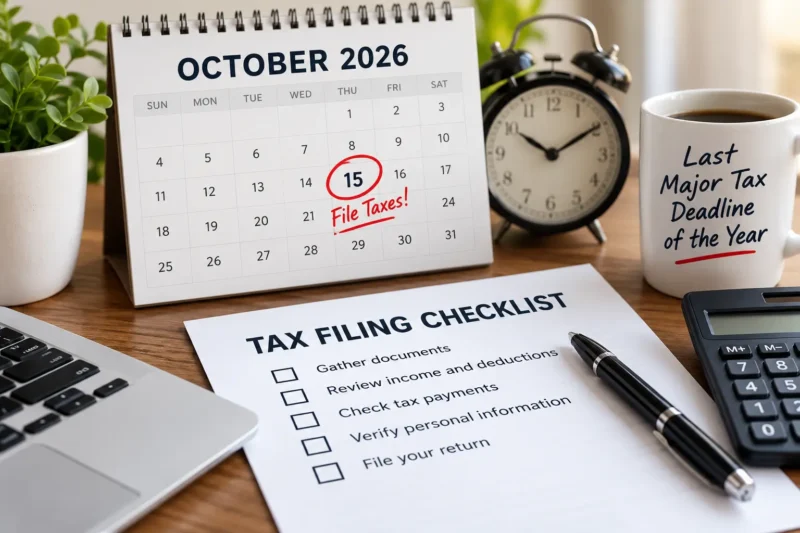
For most individual taxpayers who timely requested an extension for their 2025 federal income tax return, the extended filing deadline is Thursday, October 15, 2026. The IRS lists October 15 as the last date for transmitting returns on a Form 4868 extension. IRS
If you still haven’t filed, don’t spend the next two weeks worrying about how late you’ve left it. Use them.
There is enough time to collect missing documents, finish your return, check your numbers and file without turning October 15 into an all-night tax session.
The key is knowing what needs to happen first.
We’ve broken it down into a practical action plan you can start today.
Want something you can keep beside you while you work? Download our October 15 Tax Extension Deadline Checklist
Table of Contents
First, Understand What Your Tax Extension Actually Did
There’s one important misconception to clear up before doing anything else.
A tax extension gave you extra time to file. It did not give you extra time to pay your taxes.
For most taxpayers, the deadline to pay 2025 federal income tax was still April 15, 2026. The extension moved the deadline for submitting the return to October 15, but it didn’t move the payment deadline. The IRS notes that unpaid tax can be subject to interest and potentially penalties. IRS
Here’s a simple example.
Suppose you estimated in April that your total tax bill would be $4,000. You had already paid $3,000 through withholding and made a $700 extension payment.
You finish your return in October and discover the actual amount due was $4,200.
That leaves another $500 unpaid.
Your extension allows you to file the completed return by October 15, but it doesn’t make that $500 an October payment. It was generally due in April.
That’s also why you shouldn’t avoid filing simply because you’re worried that you might owe money.
Filing the return and paying the balance are related, but they’re not the same task.
If you can’t pay everything you owe, file your return and pay as much as you reasonably can. The IRS provides payment options for taxpayers who cannot pay their balance in full and advises taxpayers to pay as much as possible to limit additional interest and penalties. IRS
Your October 15 Filing Action Plan
If you’ve been putting your return off because the whole thing feels like one big job, stop treating it as one.
Break it into smaller jobs over the days you have left.
10 to 14 Days Before the Deadline: Gather Everything
Start by creating one place for your tax records.
It can be a folder on your computer, a physical folder on your desk, or both.
Then collect the documents that apply to your situation, including:
- W-2s from employers
- 1099 forms
- Bank interest statements
- Brokerage and investment statements
- Freelance and gig-work income records
- Business income and expense records
- Mortgage-related documents
- Records supporting relevant deductions and credits
- Estimated tax payment records
- Confirmation of any payment you made when requesting your extension
- Your previous year’s tax return
Don’t assume that a missing piece of paper means you never received the document. Check your email and log into the online portals for your employer, bank, brokerage, payment platform and other financial providers.
Many tax documents are delivered electronically now.
Your IRS Individual Online Account can also provide access to account information and transcripts that may help you identify records you’re missing. IRS
Practical tip: As you gather documents, make two folders: Ready and Missing.
Anything you already have goes into Ready. Anything you need to locate goes onto a short Missing list.
Suddenly, instead of thinking “My taxes aren’t ready,” you might discover that you’re actually waiting for only two documents.
That’s a much easier problem to solve.
5 to 9 Days Before: Complete the Return
Once your documents are together, start completing the actual return.
Work through:
Income → deductions → credits → payments → refund or balance due.
Don’t rush uncertain entries just to keep moving.
Instead, create a small Need to Verify list.
For example:
1099 from freelance client doesn’t match my records.
Need to confirm estimated payment from January.
Check whether home office expense qualifies.
That lets you continue working without forgetting the issue.
By the end of this stage, your goal is to have a substantially complete return with only a handful of questions remaining.
2 to 4 Days Before: Review, Don’t Just Recalculate
Once the return is finished, stop looking at it as the person who prepared it.
Look at it as someone trying to find a mistake.
Compare the income on your return against your tax documents. Check whether estimated payments were entered. Review dependents. Look at your filing status.
Then inspect the simple things that are surprisingly easy to get wrong:
Names. Social Security numbers. Address. Bank account number. Routing number.
If you’re self-employed, spend extra time reconciling your gross income and expenses against your records.
October 14: Get Ready to File
Ideally, October 14 should be boring.
You shouldn’t still be hunting for six-month-old documents or trying to decide whether an expense qualifies.
Use the day to complete a final review, save a copy of your return and make sure you can access the tax software or filing method you’re planning to use.
If someone else is preparing your taxes, don’t assume they’re waiting for your documents with nothing else to do. Contact them well before the deadline.
October 15: File and Save the Evidence
File your return.
Then save your filing acknowledgment, confirmation or other evidence that the return was submitted.
Don’t close the browser and assume you’ll be able to find everything later.
Create a folder called something obvious, such as 2025 Tax Return – Filed, and put the final return and relevant confirmations there.
“I’m Still Missing a Tax Document. What Do I Do?”
This is one of the most common reasons people reach the extension deadline without a completed return.
Maybe you can’t find a 1099. Perhaps you changed jobs and don’t have access to your former employer’s portal anymore. Or an investment account you barely used has slipped your mind.
Whatever the reason, don’t simply leave known income off the return because you can’t find the form.
Start with the obvious places.
Search your email for terms such as “tax document,” “W-2,” “1099” and the name of the company involved.
Log into the relevant account. Check its tax-document or statements section.
Contact the issuer if necessary.
Then look at last year’s return.
Last year’s taxes can be surprisingly useful as a checklist. If you received a 1099 from the same bank last year, for example, ask yourself whether you should have one this year too.
You can also review information available through your IRS account and transcripts. The IRS specifically recommends that extension filers gather and review their records because complete records can help reduce errors and delays. IRS
The goal isn’t to make your return look complete.
It’s to make it actually complete.
Give Your Return a Five-Question Reality Check
When you’ve been staring at tax forms for hours, it’s easy to stop seeing what’s in front of you.
Before filing, step away for a while. Then come back and ask these five questions.
1. Did I Report All My Income?
Don’t think only about your primary job.
Think about freelance projects, consulting, gig work, interest, investments, rental income and other taxable income that may apply to your situation.
Ask yourself a simple question:
Where did money come from during 2025?
Then compare the answer with your return.
2. Did I Include Payments I’ve Already Made?
If you made estimated payments during the year or paid money when requesting your extension, make sure those payments are properly accounted for.
Otherwise, your return could appear to show a larger balance than you actually owe.
3. Can I Support the Deductions and Credits I’m Claiming?
October 15 isn’t the time to become more aggressive simply because you don’t like the number on the screen.
If you’re claiming a deduction or credit, make sure you understand why you qualify and have the appropriate records to support it.
If you’re uncertain, verify it before filing.
4. Is My Personal Information Correct?
Check:
- Your legal name
- Social Security number or taxpayer identification number
- Spouse’s information, if applicable
- Dependent information
- Filing status
- Current address
These checks take minutes.
5. Are My Payment or Refund Details Correct?
If you’re entering banking information, compare the numbers directly with your bank records.
Don’t type them from memory.
A nine-digit routing number can look perfectly normal while still being completely wrong.
What If You Can’t Pay Your Tax Bill?
This is the point where some taxpayers freeze.
You finish the return, expecting a small refund, and instead see:
Amount you owe: $3,200.
You don’t have $3,200 available.
So what do you do?
First, don’t treat “I can’t pay the entire bill” as “I can’t file my return.”
Those are two separate problems.
For example, suppose you owe $3,200 but can currently afford $1,000.
Rather than ignoring the return, you can file by the applicable deadline, pay what you can and investigate options for dealing with the remaining balance. The IRS says taxpayers who cannot pay in full should pay as much as they can and provides online payment-plan options. IRS
Waiting doesn’t make the underlying tax disappear.
If anything, knowing the exact amount you owe puts you in a better position to decide what to do next.
What Happens If You Miss October 15?
If you timely requested the standard six-month extension, October 15 is the deadline for your return to be considered timely under that extension. IRS
That doesn’t necessarily mean the IRS stops accepting returns at midnight and you can never file again.
In fact, the IRS says electronically filed returns are generally accepted into November, with the exact annual shutdown date announced separately. But the availability of e-filing after October 15 doesn’t extend your timely filing deadline. IRS
So if you miss October 15, don’t make the mistake of thinking:
“Well, I’m late now anyway. I’ll deal with it next month.”
Deal with it as soon as possible.
A short delay doesn’t need to become a long one.
Also keep in mind that October 15 isn’t necessarily everyone’s deadline. Special rules can apply to taxpayers affected by certain federally declared disasters, taxpayers serving in combat zones and some taxpayers outside the United States. IRS
If one of those situations applies to you, check the specific IRS rules rather than assuming the standard October 15 deadline controls your return.
Your Final October 15 Tax Checklist
Before considering the job finished, run through this one final time:
☐ All tax documents collected
☐ All income sources included
☐ Deductions and credits reviewed
☐ Estimated tax payments entered
☐ Extension payment accounted for
☐ Personal information verified
☐ Dependent information checked
☐ Bank details verified
☐ Refund or amount owed confirmed
☐ Return reviewed for obvious errors
☐ Required forms and schedules included
☐ Return filed
☐ Filing confirmation saved
☐ Final copy stored securely
Want to work through the list away from your screen?
Download October 15 Tax Extension Deadline Checklist – by TaxBraix.com – It gives you a simple checklist you can print and check off as you prepare, review and file your return.
Make October 15 the Day You File, Not the Day You Start
The October deadline has a way of sneaking up on people.
You filed the extension in April because you needed more time. Now the most useful thing you can do with that extra time is actually use the days you have left.
Start gathering your records today.
Identify what’s missing. Complete the return. Resolve the questions you uncover. Then give yourself enough time to review everything without a countdown clock running in the background.
Don’t make October 15 the day you start looking for your tax documents. Make it the day you submit a return you’ve already checked.
That’s a much better way to finish the year’s major individual tax filing season.